The big idea
An object moving in a circle at constant speed is accelerating, because its direction keeps changing. The acceleration points to the centre, so a resultant centripetal force toward the centre must act. It is never an extra force: it is provided by tension, friction, gravity or a normal reaction.
Key ideas
- Angles are measured in radians: 2π rad = 360°. Angular velocity ω = 2π/T = 2πf.
- Linear speed v = rω.
- Centripetal acceleration a = v²/r = rω², directed toward the centre.
- The centripetal force does no work, because it is always at right angles to the velocity.
Equations
| ω = 2π / T | angular velocity |
| v = rω | |
| a = v² / r = rω² | |
| F = mv² / r = mrω² | centripetal force |
Worked example
A 900 kg car takes a level bend of radius 50 m at 15 m s⁻¹. Find the centripetal force and say what provides it.
- F = mv²/r = 900 × 15²/50.
- F = 4050 N, toward the centre of the bend.
- It is provided by friction between the tyres and the road.
Common mistakes
- Drawing a "centrifugal force" on a free-body diagram.
- Using degrees in v = rω.
Try it yourself
A satellite orbits once every 90 minutes. Find its angular velocity.
Show the answer
ω = 2π/(5400) = 1.16 × 10⁻³ rad s⁻¹.
Going deeper: A Level exam level
Exam technique, a longer multi-step worked example and exam-style practice with hidden solutions.
Resolving forces in circular motion
Draw the real forces, then resolve vertically (no vertical acceleration) and horizontally toward the centre (resultant = mv²/r). For a conical pendulum or a banked track this gives tan θ = v²/(rg). In a vertical circle, the contact force or tension is smallest at the top: the object just stays on the circle when mg alone provides the centripetal force, v = √(gr).
More worked examples
Example 1. A conical pendulum has a string of length 0.80 m making 30° with the vertical. Find the speed of the bob and the period of its motion.
- Radius of the circle: r = 0.80 sin 30° = 0.40 m.
- Vertical: T cos θ = mg. Horizontal: T sin θ = mv²/r. Dividing: tan θ = v²/(rg).
- v = √(0.40 × 9.81 × tan 30°) = 1.5 m s⁻¹.
- Period = 2πr/v = 2π × 0.40/1.5 = 1.7 s.
Exam-style practice
1. What is the minimum speed at the top of a vertical circle of radius 0.90 m for water to stay in a bucket?
Show the solution
v = √(gr) = √(9.81 × 0.90) = 3.0 m s⁻¹.
2. At what speed does a car lose contact with the road at the top of a hump-back bridge of radius 40 m?
Show the solution
v = √(gr) = √(9.81 × 40) = 20 m s⁻¹.
Where this fits in each exam board
| Cambridge International AS & A Level (9702) | A Level 12: Motion in a circle |
| Edexcel International A Level | Unit 4: Further mechanics |
| AQA A Level (7408) | 3.6.1 Periodic motion |
4 questions to print or save, with full step-by-step answers at the end.
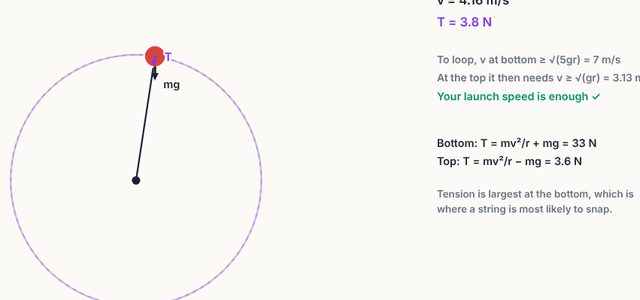
Open the Vertical Circles & Curves simulation and test every idea on this page yourself.
Open the simulation →