The big idea
Simple harmonic motion happens whenever the acceleration is proportional to the displacement from a fixed point and directed toward it. Its period does not depend on the amplitude. Real oscillators lose energy (damping), and respond strongly when driven at their natural frequency (resonance).
Key ideas
- Defining equation: a = −ω²x. The minus sign means the acceleration always points back to equilibrium.
- Displacement, velocity and acceleration are all sinusoidal. Velocity leads displacement by a quarter cycle.
- Energy swaps between kinetic and potential; the total is constant if there is no damping.
- Damping: light (amplitude decays gradually), critical (returns to rest in the shortest time without oscillating), heavy (returns slowly).
- Resonance: maximum amplitude when the driving frequency equals the natural frequency. Damping lowers and broadens the peak.
Equations
| a = −ω²x | definition |
| x = x₀ cos ωt | |
| v = ±ω√(x₀² − x²) | |
| T = 2π√(m / k), T = 2π√(l / g) | spring, pendulum |
| E = ½mω²x₀² | total energy |
Worked example
An object moves with x = 0.050 cos(4πt), with x in metres and t in seconds. Find the frequency, the maximum speed and the maximum acceleration.
- ω = 4π rad s⁻¹, so f = ω/2π = 2.0 Hz.
- vmax = ωx₀ = 4π × 0.050 = 0.63 m s⁻¹.
- amax = ω²x₀ = (4π)² × 0.050 = 7.9 m s⁻².
Common mistakes
- Leaving the calculator in degrees when evaluating cos ωt.
- Thinking a larger amplitude means a longer period.
Try it yourself
A 0.20 kg mass on a spring oscillates with period 0.50 s. Find the spring constant.
Show the answer
k = 4π²m/T² = 4π² × 0.20/0.25 = 32 N m⁻¹.
Going deeper: A Level exam level
Exam technique, a longer multi-step worked example and exam-style practice with hidden solutions.
Energy and resonance
In SHM the kinetic energy is greatest at the centre and zero at the ends, and the potential energy does the opposite. Each varies at twice the frequency of the motion. Resonance is useful (tuning circuits, microwave ovens, musical instruments) and sometimes dangerous (bridges, machinery), where damping is added to reduce the amplitude.
More worked examples
Example 1. A simple pendulum of length 1.2 m has a 0.10 kg bob and swings with amplitude 5.0 cm. Find the period, the maximum speed, the total energy and the speed when the displacement is 3.0 cm.
- T = 2π√(l/g) = 2π√(1.2/9.81) = 2.2 s, so ω = 2π/T = 2.86 rad s⁻¹.
- vmax = ωx₀ = 2.86 × 0.050 = 0.14 m s⁻¹.
- E = ½mω²x₀² = ½ × 0.10 × 2.86² × 0.050² = 1.0 × 10⁻³ J.
- v = ω√(x₀² − x²) = 2.86 × √(0.050² − 0.030²) = 2.86 × 0.040 = 0.11 m s⁻¹.
Exam-style practice
1. The mass on a spring is doubled. What happens to the period?
Show the solution
T ∝ √m, so it increases by a factor of √2.
2. Why are soldiers told to break step when crossing a footbridge?
Show the solution
Marching in step could drive the bridge at its natural frequency, causing resonance and a large amplitude.
Where this fits in each exam board
| Cambridge International AS & A Level (9702) | A Level 17: Oscillations |
| Edexcel International A Level | Unit 5: Oscillations |
| AQA A Level (7408) | 3.6.1 Periodic motion |
4 questions to print or save, with full step-by-step answers at the end.
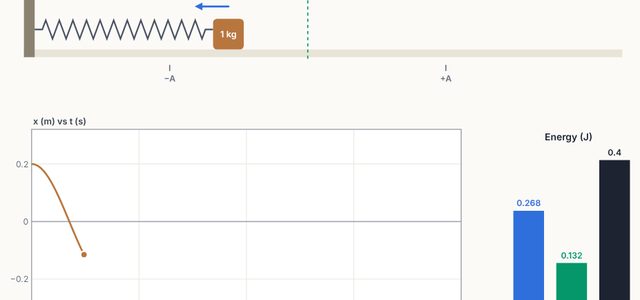
Open the Simple Harmonic Motion simulation and test every idea on this page yourself.
Open the simulation →