The big idea
The internal energy of a body is the sum of the random kinetic and potential energies of its molecules. For an ideal gas there are no forces between molecules, so the internal energy is purely kinetic and depends only on the absolute temperature.
Key ideas
- Thermal equilibrium: no net energy flow between bodies at the same temperature.
- ΔE = mcΔθ for a temperature change; E = mL for a change of state.
- The ideal gas equation pV = nRT = NkT combines Boyle's, Charles's and the pressure laws.
- Kinetic theory assumptions: many identical molecules in random motion, elastic collisions, negligible volume and no intermolecular forces.
- The mean kinetic energy of a molecule is (3/2)kT, so temperature measures molecular kinetic energy.
Equations
| pV = nRT = NkT | ideal gas |
| pV = ⅓Nm<c²> | kinetic theory |
| ½m<c²> = (3/2)kT | mean kinetic energy |
| ΔE = mcΔθ, E = mL |
Worked example
A cylinder holds gas at 2.0 × 10⁵ Pa in a volume of 0.050 m³ at 300 K. Find the number of moles and the mean kinetic energy of a molecule.
- n = pV/(RT) = (2.0 × 10⁵)(0.050)/(8.31 × 300) = 4.0 mol.
- Mean KE = (3/2)kT = 1.5 × 1.38 × 10⁻²³ × 300 = 6.2 × 10⁻²¹ J.
Common mistakes
- Using °C in pV = nRT.
- Confusing n (moles) with N (molecules): N = n × 6.02 × 10²³.
Try it yourself
By what factor does the r.m.s. speed of gas molecules change when the temperature rises from 300 K to 1200 K?
Show the answer
crms ∝ √T, so it doubles.
Going deeper: A Level exam level
Exam technique, a longer multi-step worked example and exam-style practice with hidden solutions.
The first law of thermodynamics
The increase in internal energy of a system equals the energy supplied by heating plus the work done on it: ΔU = q + W (Cambridge convention). At constant pressure, the work done by a gas is pΔV. For an ideal gas, U depends only on temperature, so an isothermal change has ΔU = 0.
More worked examples
Example 1. A gas at a constant pressure of 1.0 × 10⁵ Pa expands from 2.0 × 10⁻³ m³ to 5.0 × 10⁻³ m³ while 900 J of thermal energy is supplied. Find the work done by the gas and the change in internal energy. Then find the r.m.s. speed of nitrogen molecules (m = 4.65 × 10⁻²⁶ kg) at 300 K.
- Work done by the gas = pΔV = 1.0 × 10⁵ × 3.0 × 10⁻³ = 300 J.
- Work done on the gas is −300 J, so ΔU = 900 − 300 = +600 J.
- ½m<c²> = (3/2)kT → crms = √(3kT/m) = √(3 × 1.38 × 10⁻²³ × 300/4.65 × 10⁻²⁶).
- crms = 520 m s⁻¹.
Exam-style practice
1. 0.20 kg of water at 80 °C is mixed with 0.30 kg of water at 20 °C. Find the final temperature.
Show the solution
Energy lost = energy gained: 0.20(80 − θ) = 0.30(θ − 20), so θ = 44 °C.
2. How many molecules are in 1.0 m³ of gas at 1.0 × 10⁵ Pa and 300 K?
Show the solution
N = pV/kT = 1.0 × 10⁵/(1.38 × 10⁻²³ × 300) = 2.4 × 10²⁵.
Where this fits in each exam board
| Cambridge International AS & A Level (9702) | A Level 14–16: Temperature, Ideal gases, Thermodynamics |
| Edexcel International A Level | Unit 5: Thermodynamics |
| AQA A Level (7408) | 3.6.2 Thermal physics |
4 questions to print or save, with full step-by-step answers at the end.
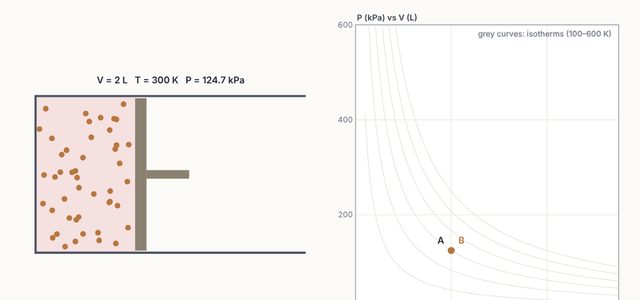
Open the Gas Laws & PV Diagrams simulation and test every idea on this page yourself.
Open the simulation →