The big idea
A gravitational field is a region where a mass feels a force. Around a point or spherical mass the field is radial and follows an inverse square law. Gravitational potential describes the energy per kilogram at each point, and is always negative.
Key ideas
- Field strength g is the force per unit mass. Near a planet's surface it is nearly uniform.
- Potential φ is the work done per unit mass in bringing a small mass from infinity. It is zero at infinity and negative everywhere else.
- Field strength = −(potential gradient).
- For a circular orbit, gravity is the centripetal force, which leads to T² ∝ r³.
- A geostationary satellite orbits above the equator with a 24-hour period, staying over one point.
Equations
| F = GMm / r² | Newton's law |
| g = GM / r² | field strength |
| φ = −GM / r | potential |
| T² = (4π² / GM)r³ | orbits |
| vesc = √(2GM / R) | escape velocity |
Worked example
Find the gravitational potential at Earth's surface and the escape velocity. (M = 5.97 × 10²⁴ kg, R = 6.37 × 10⁶ m)
- φ = −GM/R = −(6.67 × 10⁻¹¹)(5.97 × 10²⁴)/(6.37 × 10⁶) = −6.25 × 10⁷ J kg⁻¹.
- To escape, the kinetic energy per kg must equal 6.25 × 10⁷ J: ½v² = GM/R.
- v = √(2 × 6.25 × 10⁷) = 1.12 × 10⁴ m s⁻¹ (11.2 km s⁻¹).
Common mistakes
- Measuring r from the surface. It is always from the centre of the mass.
- Dropping the minus sign in the potential.
Try it yourself
At what height above Earth's surface is g one quarter of its surface value?
Show the answer
g ∝ 1/r², so r = 2R: a height of one Earth radius (6.4 × 10⁶ m).
Going deeper: A Level exam level
Exam technique, a longer multi-step worked example and exam-style practice with hidden solutions.
Energy in gravitational fields
The gravitational potential energy of a mass m is mφ = −GMm/r. To move between two distances the work done is mΔφ, which is also the area under a force–distance graph. Equipotential surfaces around a planet are spheres; no work is done moving along one.
More worked examples
Example 1. Find the radius of a geostationary orbit, and the gain in potential energy when a 1000 kg satellite is raised to it from the Earth's surface. (GM = 3.98 × 10¹⁴ N m² kg⁻¹, R = 6.37 × 10⁶ m, T = 86 400 s)
- r³ = GMT²/4π² = (3.98 × 10¹⁴)(86 400)²/39.5 = 7.53 × 10²² m³.
- r = 4.22 × 10⁷ m, about 36 000 km above the surface.
- ΔEp = GMm(1/R − 1/r) = 3.98 × 10¹⁷ × (1.570 × 10⁻⁷ − 0.237 × 10⁻⁷).
- ΔEp = 5.3 × 10¹⁰ J.
Exam-style practice
1. Find g at the surface of Mars (M = 6.42 × 10²³ kg, R = 3.39 × 10⁶ m).
Show the solution
g = GM/R² = (6.67 × 10⁻¹¹ × 6.42 × 10²³)/(3.39 × 10⁶)² = 3.7 N kg⁻¹.
2. How does the orbital speed change if the orbital radius doubles?
Show the solution
v = √(GM/r), so it falls by a factor of √2.
Where this fits in each exam board
| Cambridge International AS & A Level (9702) | A Level 13: Gravitational fields |
| Edexcel International A Level | Unit 5: Gravitational fields |
| AQA A Level (7408) | 3.7.2 Gravitational fields |
4 questions to print or save, with full step-by-step answers at the end.
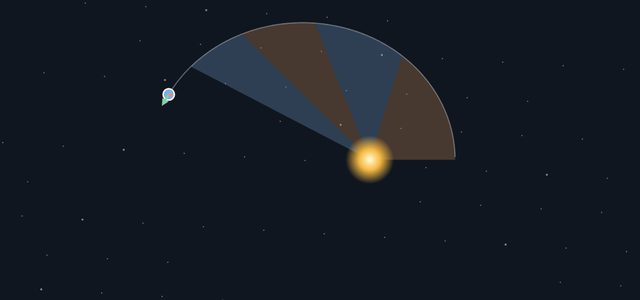
Open the Orbits & Kepler's Laws simulation and test every idea on this page yourself.
Open the simulation →