The big idea
An electric field is a region where a charge feels a force. It closely parallels the gravitational field, with one difference: charges can be positive or negative, so the force can attract or repel. Fields from several charges add as vectors; potentials add as scalars.
Key ideas
- Field strength E is the force per unit positive charge. Field lines point away from positive and toward negative charges.
- Between parallel plates the field is uniform: E = V/d.
- Around a point charge the field is radial: E = Q/(4πε₀r²).
- Potential V is the work done per unit positive charge brought from infinity: V = Q/(4πε₀r). It can be positive or negative.
- A charge moving across a uniform field follows a parabola, like a projectile.
Equations
| F = Q₁Q₂ / (4πε₀r²) | Coulomb's law |
| E = F / Q | |
| E = V / d | uniform field |
| E = Q / (4πε₀r²) | radial field |
| V = Q / (4πε₀r) | potential |
Worked example
Two parallel plates 2.0 cm apart have 5.0 kV across them. Find the field strength, and the force and acceleration of an electron between them.
- E = V/d = 5000/0.020 = 2.5 × 10⁵ V m⁻¹.
- F = eE = 1.6 × 10⁻¹⁹ × 2.5 × 10⁵ = 4.0 × 10⁻¹⁴ N.
- a = F/m = 4.0 × 10⁻¹⁴/9.11 × 10⁻³¹ = 4.4 × 10¹⁶ m s⁻², toward the positive plate.
Structured problems with diagrams
Longer problems solved one decision at a time: draw the diagram, find each force or field, resolve it into components, then add.
Problem 1. Field (and potential) from two unequal, opposite charges
q₁ = +8.0 nC is at the origin and q₂ = −6.0 nC is at (0.60 m, 0). Point P is at (0.30 m, 0.40 m). Find the electric field at P (magnitude and direction) and the potential at P.
- Distances and anglesP is 0.50 m from each charge (3-4-5 triangles), so each line to P makes an angle with the x-axis where cos = 0.30/0.50 = 0.60 and sin = 0.40/0.50 = 0.80.
- MagnitudesE₁ = kq₁/r² = (8.99 × 10⁹)(8.0 × 10⁻⁹)/(0.50)² = 288 N/C. E₂ = (8.99 × 10⁹)(6.0 × 10⁻⁹)/(0.50)² = 216 N/C.
- DirectionsImagine a positive test charge at P. q₁ pushes it away: up and to the right. q₂ pulls it in: down and to the right.
- ComponentsE₁ = (288 × 0.60, 288 × 0.80) = (173, 230) N/C. E₂ = (216 × 0.60, −216 × 0.80) = (129, −173) N/C.
- AddEx = 173 + 129 = 302 N/C. Ey = 230 − 173 = 58 N/C.
- Magnitude and directionE = √(302² + 58²) = 307 N/C, at tan⁻¹(58/302) = 11° above the +x axis.
- Potential is a scalarNo components are needed: V = kq₁/r + kq₂/r = (8.99 × 10⁹)(8.0 − 6.0) × 10⁻⁹/0.50 = +36 V.
Problem 2. Using symmetry: a point on the perpendicular bisector
Two +5.0 nC charges are 6.0 cm apart. Point P is 4.0 cm from the midpoint, on the perpendicular bisector of the line joining them. Find the electric field at P.
- DistanceEach charge is √(3.0² + 4.0²) = 5.0 cm from P.
- Magnitude of each fieldE₁ = E₂ = kq/r² = (8.99 × 10⁹)(5.0 × 10⁻⁹)/(0.050)² = 1.80 × 10⁴ N/C, each pointing away from its charge.
- Use symmetry before calculatingE₁ leans right and E₂ leans left by the same angle, so the x-components are equal and opposite and cancel. Only the y-components survive.
- Vertical componentsEach field makes an angle with the vertical where sin (toward the vertical) = 4.0/5.0 = 0.80, so Ey = 1.80 × 10⁴ × 0.80 = 1.44 × 10⁴ N/C each.
- AddE = 2 × 1.44 × 10⁴ = 2.9 × 10⁴ N/C, pointing directly away from the midpoint.
- General resultFor charges ±a from the midpoint and P a distance y along the bisector: E = 2kqy/(a² + y²)3/2.
Problem 3. Three charges at the corners of a square
A square has sides of 0.20 m. Charges of +3.0 nC sit at the top-left and bottom-right corners, and −6.0 nC sits at the bottom-left corner. Find the electric field at the empty top-right corner, P.
- DistancesThe two positive charges are 0.20 m from P. The negative charge is across the diagonal: 0.20√2 = 0.283 m, so r² = 0.080 m².
- MagnitudesE₁ = E₂ = (8.99 × 10⁹)(3.0 × 10⁻⁹)/(0.20)² = 674 N/C. E₃ = (8.99 × 10⁹)(6.0 × 10⁻⁹)/0.080 = 674 N/C.
- DirectionsE₁ (from the top-left charge) points in +x. E₂ (from the bottom-right charge) points in +y. E₃ points toward the negative charge, along the diagonal: 45° below the −x axis.
- Components of E₃E₃x = E₃y = −674 cos 45° = −477 N/C.
- AddEx = 674 − 477 = 197 N/C. Ey = 674 − 477 = 197 N/C.
- Magnitude and directionE = 197√2 = 279 N/C, at 45° above the +x axis: along the diagonal, pointing away from the square.
Common mistakes
- Adding field strengths as numbers when the fields point in different directions.
- Forgetting that the force on a negative charge is opposite to the field direction.
Try it yourself
Find the potential 0.10 m from a +2.0 nC point charge. (1/4πε₀ = 8.99 × 10⁹ N m² C⁻²)
Show the answer
V = 8.99 × 10⁹ × 2.0 × 10⁻⁹/0.10 = 180 V.
Going deeper: A Level exam level
Exam technique, a longer multi-step worked example and exam-style practice with hidden solutions.
Charged particles crossing a uniform field
The field gives a constant force, and so a constant acceleration, at right angles to the plates. The velocity component parallel to the plates is unchanged. This is exactly the projectile problem: find the time from the parallel motion, then use it in the perpendicular motion.
More worked examples
Example 1. An electron travelling at 3.0 × 10⁷ m s⁻¹ enters the space between plates 5.0 cm long, at right angles to a field of 2.0 × 10⁴ V m⁻¹. Find its sideways deflection and the angle at which it leaves.
- Time between the plates: t = 0.050/3.0 × 10⁷ = 1.67 × 10⁻⁹ s.
- a = eE/m = (1.6 × 10⁻¹⁹ × 2.0 × 10⁴)/9.11 × 10⁻³¹ = 3.5 × 10¹⁵ m s⁻².
- Deflection = ½at² = 4.9 mm.
- Sideways velocity = at = 5.9 × 10⁶ m s⁻¹, so the angle = tan⁻¹(5.9 × 10⁶/3.0 × 10⁷) = 11°.
Exam-style practice
1. How much work is done moving a +2.0 µC charge through a potential difference of 500 V?
Show the solution
W = QV = 1.0 mJ.
2. Charges +4Q and +Q are a distance d apart. Where is the field zero?
Show the solution
4Q/x² = Q/(d − x)² gives x = 2d/3 from the +4Q charge.
Where this fits in each exam board
| Cambridge International AS & A Level (9702) | A Level 18: Electric fields |
| Edexcel International A Level | Unit 4: Electric and magnetic fields |
| AQA A Level (7408) | 3.7.3 Electric fields |
4 questions to print or save, with full step-by-step answers at the end.
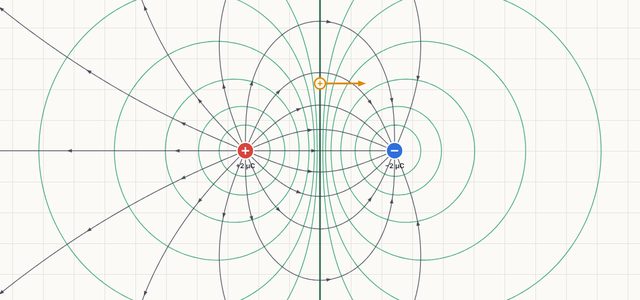
Open the Electric Field Explorer simulation and test every idea on this page yourself.
Open the simulation →