The big idea
A capacitor stores charge, and with it energy. Its capacitance is the charge stored per volt. When it discharges through a resistor, the charge, current and voltage all fall exponentially, with a time constant RC.
Key ideas
- C = Q/V, in farads. Practical capacitors are measured in µF, nF or pF.
- In parallel, capacitances add. In series, their reciprocals add (the opposite of resistors).
- Energy stored = area under the Q–V graph = ½QV.
- In one time constant τ = RC, a discharging capacitor falls to 37% (1/e) of its initial value.
- A graph of ln V against t is a straight line of gradient −1/RC.
Equations
| C = Q / V | |
| W = ½QV = ½CV² | energy stored |
| x = x₀ e−t/RC | discharge (x = Q, V or I) |
| τ = RC | time constant |
Worked example
A 470 µF capacitor is charged to 12 V and then discharged through a 10 kΩ resistor. Find the charge and energy stored, the time constant, and the p.d. after 4.7 s.
- Q = CV = 470 × 10⁻⁶ × 12 = 5.6 mC.
- W = ½CV² = ½ × 470 × 10⁻⁶ × 144 = 34 mJ.
- τ = RC = 10 000 × 470 × 10⁻⁶ = 4.7 s.
- After one time constant V = 12 × e⁻¹ = 4.4 V.
Common mistakes
- Adding capacitances in series.
- Thinking the capacitor is fully discharged after one time constant.
Try it yourself
How long does the capacitor above take to fall to half its initial voltage?
Show the answer
t = RC ln 2 = 4.7 × 0.693 = 3.3 s.
Going deeper: A Level exam level
Exam technique, a longer multi-step worked example and exam-style practice with hidden solutions.
Parallel-plate capacitors and sharing charge
For parallel plates, C = ε₀εrA/d (AQA and Edexcel): a dielectric increases the capacitance by the factor εr. When a charged capacitor is connected across an uncharged one, charge is conserved and both end at the same p.d., but energy is lost as heat in the connecting wires.
More worked examples
Example 1. A 100 µF capacitor charged to 9.0 V is connected across an uncharged 200 µF capacitor. Find the final p.d. and the energy before and after.
- Q = CV = 100 × 10⁻⁶ × 9.0 = 900 µC, and it is conserved.
- They are in parallel: V = Q/(C₁ + C₂) = 900/300 = 3.0 V.
- Before: ½CV² = ½ × 100 × 10⁻⁶ × 81 = 4.05 mJ.
- After: ½ × 300 × 10⁻⁶ × 9.0 = 1.35 mJ. Two-thirds of the energy is dissipated.
Exam-style practice
1. A 100 µF capacitor discharges through 22 kΩ. Find the time constant and the time for the p.d. to fall to 10% of its initial value.
Show the solution
τ = 2.2 s; t = τ ln 10 = 5.1 s.
2. Find the capacitance of plates 0.10 m × 0.10 m, 1.0 mm apart, filled with a dielectric of εr = 4.
Show the solution
C = 8.85 × 10⁻¹² × 4 × 0.010/1.0 × 10⁻³ = 3.5 × 10⁻¹⁰ F.
Where this fits in each exam board
| Cambridge International AS & A Level (9702) | A Level 19: Capacitance |
| Edexcel International A Level | Unit 4: Electric and magnetic fields |
| AQA A Level (7408) | 3.7.4 Capacitance |
4 questions to print or save, with full step-by-step answers at the end.
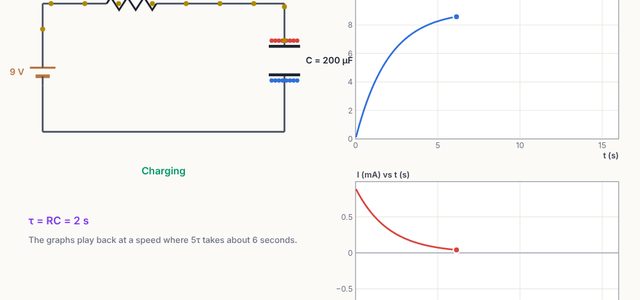
Open the RC Circuits simulation and test every idea on this page yourself.
Open the simulation →