The big idea
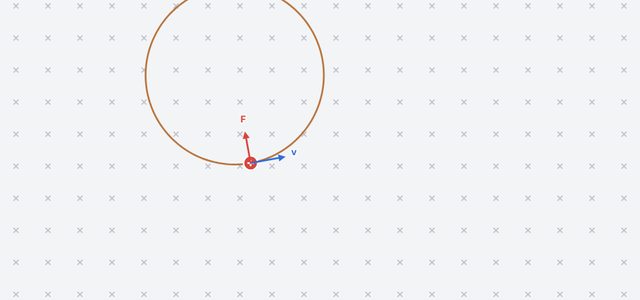
A magnetic field exerts a force on a current-carrying conductor and on a moving charge. The force is always at right angles to the motion, so a charged particle moving across a uniform field travels in a circle.
Key ideas
- Magnetic flux density B is defined by F = BIL sin θ, in tesla. Direction: Fleming's left-hand rule.
- The force on a moving charge is F = BQv sin θ.
- Because the force is perpendicular to the velocity, it does no work: the speed stays constant.
- In a velocity selector, electric and magnetic forces balance when v = E/B.
- Flux density inside a long solenoid: B = μ₀nI. Around a long straight wire: B = μ₀I/(2πr).
Equations
| F = BIL sin θ | force on a conductor |
| F = BQv sin θ | force on a charge |
| r = mv / (BQ) | radius of circular path |
| VH = BI / (ntq) | Hall voltage |
Worked example
An electron moving at 2.0 × 10⁷ m s⁻¹ enters a uniform field of 5.0 mT at right angles. Find the radius of its path.
- The magnetic force provides the centripetal force: BQv = mv²/r.
- r = mv/(BQ) = (9.11 × 10⁻³¹)(2.0 × 10⁷)/((5.0 × 10⁻³)(1.6 × 10⁻¹⁹)).
- r = 2.3 cm.
Common mistakes
- Using the left-hand rule with the electron's direction of motion. Conventional current is opposite to electron flow.
- Thinking the magnetic force speeds the particle up.
Try it yourself
What speed of particle passes undeflected through crossed fields E = 6.0 × 10⁴ V m⁻¹ and B = 0.30 T?
Show the answer
v = E/B = 2.0 × 10⁵ m s⁻¹.
Going deeper: A Level exam level
Exam technique, a longer multi-step worked example and exam-style practice with hidden solutions.
Particle accelerators (Edexcel) and the mass spectrometer
In a cyclotron, a magnetic field bends charged particles into semicircles inside two D-shaped electrodes, and an alternating voltage accelerates them each time they cross the gap. The time for each half-turn does not depend on speed, so the frequency stays fixed at f = BQ/(2πm). In a mass spectrometer, ions of the same speed follow circles of radius proportional to their mass.
More worked examples
Example 1. Protons are accelerated in a cyclotron with a field of 1.5 T. Find the frequency of the alternating voltage, and the speed and kinetic energy of protons leaving at a radius of 0.40 m.
- f = BQ/(2πm) = (1.5 × 1.6 × 10⁻¹⁹)/(2π × 1.67 × 10⁻²⁷) = 2.3 × 10⁷ Hz.
- v = BQr/m = (1.5 × 1.6 × 10⁻¹⁹ × 0.40)/1.67 × 10⁻²⁷ = 5.7 × 10⁷ m s⁻¹.
- Ek = ½mv² = 2.8 × 10⁻¹² J = 17 MeV.
Exam-style practice
1. Find the force per metre on a wire carrying 5.0 A at 30° to a field of 0.020 T.
Show the solution
F/L = BI sin θ = 0.020 × 5.0 × 0.50 = 0.050 N m⁻¹.
2. Why does a magnetic field not change the speed of a charged particle?
Show the solution
The force is always perpendicular to the velocity, so it does no work.
Where this fits in each exam board
| Cambridge International AS & A Level (9702) | A Level 20: Magnetic fields |
| Edexcel International A Level | Unit 4: Electric and magnetic fields |
| AQA A Level (7408) | 3.7.5 Magnetic fields |
4 questions to print or save, with full step-by-step answers at the end.
Open the Magnetic Force simulation and test every idea on this page yourself.
Open the simulation →