The big idea
An e.m.f. is induced in a circuit whenever the magnetic flux linkage through it changes. Faraday's law gives its size and Lenz's law gives its direction. Rotating a coil in a field produces an alternating e.m.f., which is described by its peak and r.m.s. values.
Key ideas
- Magnetic flux Φ = BA (field perpendicular to the area), in webers. Flux linkage = NΦ.
- Faraday's law: the induced e.m.f. equals the rate of change of flux linkage.
- Lenz's law: the induced e.m.f. acts to oppose the change causing it. This is conservation of energy.
- The r.m.s. value of an alternating current is the direct current that would give the same heating effect.
- Transformers change alternating voltages. Transmission at high voltage reduces I²R losses.
Equations
| Φ = BA cos θ | flux |
| ε = −Δ(NΦ) / Δt | Faraday and Lenz |
| ε = BLv | moving conductor |
| Vrms = V₀ / √2 | r.m.s. value |
| Ns / Np = Vs / Vp | transformer |
Worked example
A 200-turn coil of area 4.0 × 10⁻⁴ m² lies at right angles to a field that falls from 0.50 T to zero in 0.10 s. Find the induced e.m.f.
- Initial flux linkage = NBA = 200 × 0.50 × 4.0 × 10⁻⁴ = 0.040 Wb.
- ε = Δ(NΦ)/Δt = 0.040/0.10.
- ε = 0.40 V.
Common mistakes
- Forgetting the number of turns.
- Using the peak voltage in power calculations instead of the r.m.s. value.
Try it yourself
Mains electricity has an r.m.s. voltage of 230 V. What is the peak voltage?
Show the answer
V₀ = 230 × √2 = 325 V.
Going deeper: A Level exam level
Exam technique, a longer multi-step worked example and exam-style practice with hidden solutions.
The a.c. generator and practical transformers
A coil of N turns and area A rotating at angular speed ω in a field B has flux linkage BAN cos ωt, so the e.m.f. is BANω sin ωt, with peak value BANω. Real transformers lose energy through resistance heating of the coils and eddy currents in the core, which is why the core is laminated. A diode rectifies a.c., and a capacitor smooths the output (Cambridge).
More worked examples
Example 1. A coil of 500 turns and area 0.010 m² rotates at 50 Hz in a field of 0.20 T. Find the peak and r.m.s. e.m.f., and the mean power delivered to a 100 Ω resistor.
- ω = 2πf = 314 rad s⁻¹.
- Peak e.m.f. = BANω = 0.20 × 0.010 × 500 × 314 = 314 V.
- Vrms = 314/√2 = 222 V.
- P = Vrms²/R = 222²/100 = 490 W.
Exam-style practice
1. An aircraft with a 30 m wingspan flies at 250 m s⁻¹ through a vertical field component of 4.0 × 10⁻⁵ T. Find the e.m.f. between the wing tips.
Show the solution
ε = BLv = 4.0 × 10⁻⁵ × 30 × 250 = 0.30 V.
2. Why is a transformer core made of thin insulated sheets?
Show the solution
Laminations reduce eddy currents, and so the energy wasted heating the core.
Where this fits in each exam board
| Cambridge International AS & A Level (9702) | A Level 20: Magnetic fields; 21: Alternating currents |
| Edexcel International A Level | Unit 4: Electric and magnetic fields |
| AQA A Level (7408) | 3.7.5 Magnetic fields |
4 questions to print or save, with full step-by-step answers at the end.
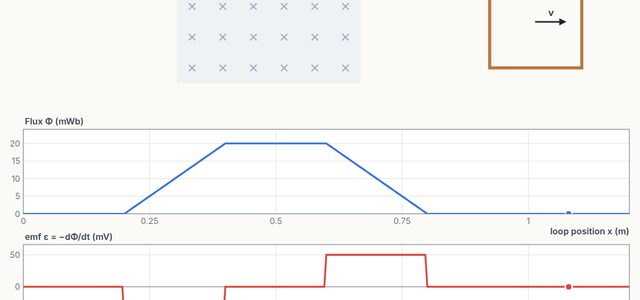
Open the Electromagnetic Induction simulation and test every idea on this page yourself.
Open the simulation →