The big idea
Light arrives in packets of energy called photons. The photoelectric effect cannot be explained by waves, and electron diffraction cannot be explained by particles. Both light and matter show wave–particle duality.
Key ideas
- Photon energy E = hf = hc/λ. The electronvolt: 1 eV = 1.6 × 10⁻¹⁹ J.
- One photon releases at most one electron, and only if hf is at least the work function φ.
- Intensity changes the number of electrons per second, not their maximum energy.
- A particle of momentum p has a de Broglie wavelength λ = h/p.
- Atoms have discrete energy levels. A photon is emitted or absorbed when an electron moves between them: hf = E₁ − E₂. This explains line spectra.
Equations
| E = hf = hc / λ | photon energy |
| hf = φ + ½mvmax² | photoelectric equation |
| λ = h / p | de Broglie |
| hf = E₁ − E₂ | energy levels |
Worked example
Ultraviolet light of wavelength 300 nm shines on zinc (φ = 4.3 eV) and on sodium (φ = 2.3 eV). What happens in each case?
- Photon energy = hc/λ = (6.63 × 10⁻³⁴)(3.0 × 10⁸)/(300 × 10⁻⁹) = 6.63 × 10⁻¹⁹ J = 4.1 eV.
- Zinc: 4.1 eV < 4.3 eV, so no electrons are emitted, however bright the light.
- Sodium: maximum kinetic energy = 4.1 − 2.3 = 1.8 eV.
Common mistakes
- Saying brighter light gives the electrons more energy.
- Mixing joules and electronvolts in one equation.
Try it yourself
Find the de Broglie wavelength of an electron moving at 1.0 × 10⁶ m s⁻¹.
Show the answer
λ = h/(mv) = 6.63 × 10⁻³⁴/(9.11 × 10⁻³¹ × 1.0 × 10⁶) = 7.3 × 10⁻¹⁰ m.
Going deeper: A Level exam level
Exam technique, a longer multi-step worked example and exam-style practice with hidden solutions.
Stopping potential, spectra and photon counting
The stopping potential Vs is the p.d. that just stops the fastest photoelectrons: eVs = hf − φ. A graph of Vs against f has gradient h/e. A useful shortcut: photon energy in eV = 1240/(wavelength in nm). For a beam of power P, the number of photons per second is P divided by the energy of one photon.
More worked examples
Example 1. An electron in hydrogen falls from the −3.40 eV level to the −13.6 eV level. Find the wavelength emitted. Then find the stopping potential when 250 nm light shines on a metal of work function 2.3 eV.
- Photon energy = 13.6 − 3.40 = 10.2 eV = 1.63 × 10⁻¹⁸ J.
- λ = hc/E = (6.63 × 10⁻³⁴ × 3.0 × 10⁸)/1.63 × 10⁻¹⁸ = 122 nm (ultraviolet).
- 250 nm photons: E = 1240/250 = 4.96 eV.
- eVs = 4.96 − 2.3 = 2.66 eV, so Vs = 2.7 V.
Exam-style practice
1. How many photons per second does a 1.0 mW laser of wavelength 633 nm emit?
Show the solution
E = hc/λ = 3.14 × 10⁻¹⁹ J; N = 1.0 × 10⁻³/3.14 × 10⁻¹⁹ = 3.2 × 10¹⁵ s⁻¹.
2. Find the de Broglie wavelength of an electron accelerated through 100 V.
Show the solution
p = √(2meV) = 5.40 × 10⁻²⁴ kg m s⁻¹; λ = h/p = 1.2 × 10⁻¹⁰ m.
Where this fits in each exam board
| Cambridge International AS & A Level (9702) | A Level 22: Quantum physics |
| Edexcel International A Level | Unit 2: Particle nature of light (first year) |
| AQA A Level (7408) | 3.2.2 Electromagnetic radiation and quantum phenomena (first year) |
4 questions to print or save, with full step-by-step answers at the end.
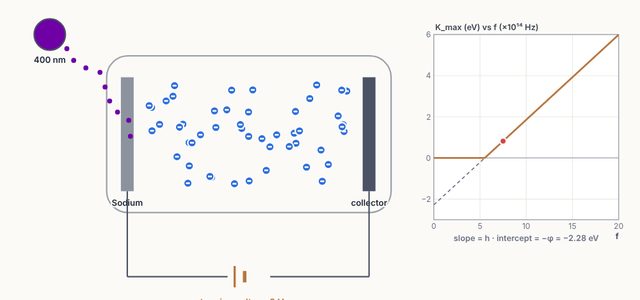
Open the Photoelectric Effect simulation and test every idea on this page yourself.
Open the simulation →