The big idea
Mass and energy are equivalent: E = mc². A nucleus has less mass than its separate nucleons, and that mass defect is the binding energy. Radioactive decay is random and spontaneous, and a large sample decays exponentially.
Key ideas
- Binding energy per nucleon is greatest near iron-56. Fusion of light nuclei and fission of heavy nuclei both move toward it and release energy.
- 1 u = 1.66 × 10⁻²⁷ kg, equivalent to 931.5 MeV.
- The decay constant λ is the probability of decay per unit time for one nucleus.
- Activity A = λN, in becquerels.
- Half-life and decay constant are linked by λt½ = ln 2.
Equations
| E = mc² | mass–energy |
| A = λN | activity |
| N = N₀ e−λt | decay law |
| λ = ln 2 / t½ |
Worked example
Carbon-14 has a half-life of 5730 years. Find its decay constant in s⁻¹ and the activity of a sample containing 1.0 × 10¹² atoms.
- t½ = 5730 × 3.16 × 10⁷ = 1.81 × 10¹¹ s.
- λ = ln 2/t½ = 0.693/1.81 × 10¹¹ = 3.8 × 10⁻¹² s⁻¹.
- A = λN = 3.8 × 10⁻¹² × 1.0 × 10¹² = 3.8 Bq.
Common mistakes
- Using the half-life in years with an activity in becquerels.
- Comparing total binding energies instead of binding energy per nucleon to judge stability.
Try it yourself
What fraction of a sample remains after a time equal to 1/λ?
Show the answer
N/N₀ = e⁻¹ = 0.37 (37%).
Going deeper: A Level exam level
Exam technique, a longer multi-step worked example and exam-style practice with hidden solutions.
Binding energy and nuclear size
To find a binding energy, add up the masses of the separate nucleons, subtract the mass of the nucleus to get the mass defect, and convert with 1 u = 931.5 MeV. The nuclear radius grows with nucleon number as R = r₀A1/3, with r₀ ≈ 1.2 fm, which means all nuclei have about the same density.
More worked examples
Example 1. Find the binding energy per nucleon of helium-4 (nuclear mass 4.001506 u; proton 1.007276 u; neutron 1.008665 u). Then estimate the radius of a gold-197 nucleus.
- Separate nucleons: 2 × 1.007276 + 2 × 1.008665 = 4.031882 u.
- Mass defect = 4.031882 − 4.001506 = 0.030376 u.
- Binding energy = 0.030376 × 931.5 = 28.3 MeV, which is 7.07 MeV per nucleon.
- R = 1.2 × 10⁻¹⁵ × 1971/3 = 1.2 × 10⁻¹⁵ × 5.82 = 7.0 × 10⁻¹⁵ m.
Exam-style practice
1. The activity of a source falls from 400 Bq to 50 Bq in 30 minutes. Find the half-life and the decay constant.
Show the solution
Three half-lives, so t½ = 10 min; λ = ln 2/600 = 1.2 × 10⁻³ s⁻¹.
2. How much energy, in joules, is equivalent to a mass of 1 u?
Show the solution
931.5 MeV = 931.5 × 10⁶ × 1.6 × 10⁻¹⁹ = 1.5 × 10⁻¹⁰ J.
Where this fits in each exam board
| Cambridge International AS & A Level (9702) | A Level 23: Nuclear physics |
| Edexcel International A Level | Unit 5: Nuclear decay |
| AQA A Level (7408) | 3.8 Nuclear physics |
4 questions to print or save, with full step-by-step answers at the end.
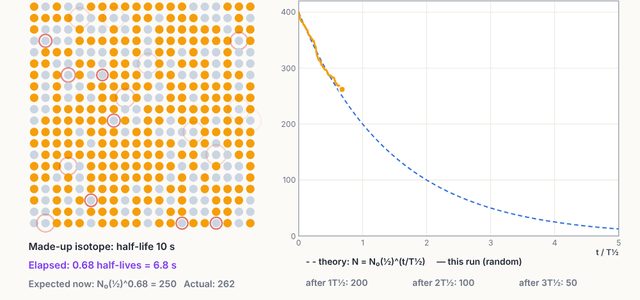
Open the Nuclear Decay & Binding Energy simulation and test every idea on this page yourself.
Open the simulation →