The big idea
A handful of experiments changed physics. Thomson measured the specific charge of the electron, Millikan showed that charge comes in whole-number multiples of e, and Einstein's special relativity showed that time and length depend on the observer's motion.
Key ideas
- Cathode rays are electrons. Balancing electric and magnetic forces (eE = Bev) gives their speed; the curvature in a magnetic field then gives e/m.
- In Millikan's experiment, a charged oil drop is held stationary when the electric force equals its weight.
- Special relativity rests on two postulates: the laws of physics are the same in all inertial frames, and the speed of light in a vacuum is the same for all observers.
- Time dilation: a moving clock runs slow by the factor γ. Length contraction: a moving object is shorter along its direction of motion by the same factor.
- Mass and energy are equivalent: E = mc².
Equations
| v = E / B | crossed fields |
| QV / d = mg | stationary oil drop |
| γ = 1 / √(1 − v² / c²) | Lorentz factor |
| t = γt₀, l = l₀ / γ | time dilation, length contraction |
Worked example
Muons have a half-life of 2.2 µs in their own rest frame. For muons travelling at 0.98c, find the half-life measured in the laboratory and the distance travelled in that time.
- γ = 1/√(1 − 0.98²) = 1/√0.0396 = 5.0.
- Laboratory half-life = γt₀ = 5.0 × 2.2 = 11 µs.
- Distance = 0.98 × 3.0 × 10⁸ × 11 × 10⁻⁶ = 3.3 km, compared with 650 m without relativity. This is why muons made in the upper atmosphere reach the ground.
Common mistakes
- Applying time dilation the wrong way round. The proper time t₀ is measured in the frame where the clock is at rest, and it is always the shortest.
- Using the plate voltage instead of the field strength V/d in Millikan calculations.
Try it yourself
An oil drop of mass 1.6 × 10⁻¹⁵ kg is held stationary in a field of 4.9 × 10⁴ V m⁻¹. Find its charge.
Show the answer
Q = mg/E = (1.6 × 10⁻¹⁵ × 9.81)/4.9 × 10⁴ = 3.2 × 10⁻¹⁹ C, which is 2e.
Going deeper: A Level exam level
Exam technique, a longer multi-step worked example and exam-style practice with hidden solutions.
Finding the specific charge of the electron
First use crossed electric and magnetic fields to select a known speed, v = E/B. Then switch off the electric field and measure the radius of the circular path in the magnetic field alone: e/m = v/(Br). Thomson's value was nearly 2000 times larger than that of the hydrogen ion, showing that the electron is far lighter than any atom.
More worked examples
Example 1. Electrons pass undeflected through crossed fields of 3.0 × 10⁴ V m⁻¹ and 1.5 × 10⁻³ T. With the electric field off, they move in a circle of radius 7.6 cm. Find their speed and specific charge. Then find the length of a 100 m spacecraft measured by an observer it passes at 0.80c.
- v = E/B = 3.0 × 10⁴/1.5 × 10⁻³ = 2.0 × 10⁷ m s⁻¹.
- e/m = v/(Br) = 2.0 × 10⁷/(1.5 × 10⁻³ × 0.076) = 1.75 × 10¹¹ C kg⁻¹.
- γ = 1/√(1 − 0.80²) = 1/0.60 = 1.67.
- Length = l₀/γ = 100 × 0.60 = 60 m.
Exam-style practice
1. What did Millikan's experiment show about electric charge?
Show the solution
Charge is quantised: every drop carried a whole-number multiple of 1.6 × 10⁻¹⁹ C.
2. Find the energy released if 1.0 mg of mass is converted entirely to energy.
Show the solution
E = mc² = 1.0 × 10⁻⁶ × 9.0 × 10¹⁶ = 9.0 × 10¹⁰ J.
Where this fits in each exam board
| Cambridge International AS & A Level (9702) | Partly in A Level 22: Quantum physics |
| Edexcel International A Level | Not a separate topic |
| AQA A Level (7408) | 3.12 Turning points in physics (optional topic) |
4 questions to print or save, with full step-by-step answers at the end.
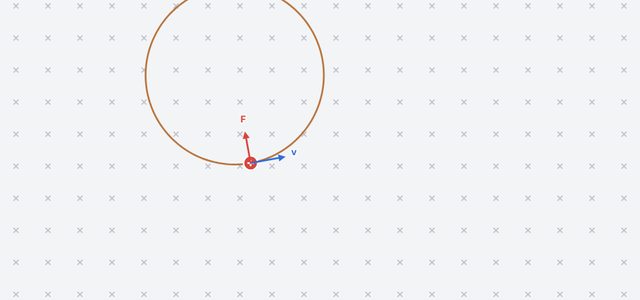
Open the Magnetic Force simulation and test every idea on this page yourself.
Open the simulation →