The big idea
Rotational motion follows the same laws as linear motion, with moment of inertia in place of mass and torque in place of force. Heat engines turn thermal energy into work, and the first and second laws of thermodynamics set limits on how well they can do it.
Key ideas
- Moment of inertia I = Σmr² measures how hard it is to change an object's rotation. It depends on how the mass is spread about the axis.
- Torque = Iα, the rotational version of F = ma.
- Angular momentum Iω is conserved when no external torque acts.
- First law: Q = ΔU + W, where W is the work done by the gas. The area inside a p–V loop is the net work per cycle.
- No engine working between TH and TC can be more efficient than 1 − TC/TH.
Equations
| T = Iα | torque |
| Ek = ½Iω² | rotational kinetic energy |
| L = Iω | angular momentum |
| W = Tθ, P = Tω | work and power |
| Q = ΔU + W | first law |
| efficiency = W / QH ≤ 1 − TC / TH |
Worked example
A flywheel with moment of inertia 0.50 kg m² starts from rest. A constant torque of 2.0 N m acts for 10 s. Find its angular acceleration, final angular speed, kinetic energy and the number of revolutions made.
- α = T/I = 2.0/0.50 = 4.0 rad s⁻².
- ω = αt = 40 rad s⁻¹.
- Ek = ½Iω² = ½ × 0.50 × 40² = 400 J.
- θ = ½αt² = 200 rad = 32 revolutions. Check: W = Tθ = 2.0 × 200 = 400 J ✓
Common mistakes
- Using the first-law sign convention from another board. Here W is work done by the gas.
- Using °C in the maximum-efficiency formula.
Try it yourself
An engine takes in 800 J from a 600 K source and rejects 500 J to a 300 K sink each cycle. Find its efficiency and the maximum possible efficiency.
Show the answer
W = 300 J, so efficiency = 300/800 = 37.5%. Maximum = 1 − 300/600 = 50%.
Going deeper: A Level exam level
Exam technique, a longer multi-step worked example and exam-style practice with hidden solutions.
Rotational collisions and indicator diagrams
When two rotating parts are coupled (a clutch), angular momentum is conserved but rotational kinetic energy is not. On a p–V (indicator) diagram, the area inside the loop is the work done per cycle, so indicated power = area × cycles per second. Real engines fall short of the ideal cycle because of friction and incomplete combustion.
More worked examples
Example 1. A flywheel of moment of inertia 0.50 kg m² spinning at 40 rad s⁻¹ is coupled to a stationary flywheel of moment of inertia 1.5 kg m². Find the final angular speed and the energy dissipated.
- Angular momentum before = 0.50 × 40 = 20 kg m² s⁻¹.
- After: (0.50 + 1.5)ω = 20, so ω = 10 rad s⁻¹.
- Energy before = ½ × 0.50 × 40² = 400 J. After = ½ × 2.0 × 10² = 100 J.
- 300 J is dissipated as heat in the clutch.
Exam-style practice
1. A motor delivers a torque of 12 N m at 150 rad s⁻¹. Find its power.
Show the solution
P = Tω = 1800 W.
2. The loop on an indicator diagram has an area of 450 J, and the engine completes 20 cycles per second. Find the indicated power.
Show the solution
450 × 20 = 9.0 kW.
Where this fits in each exam board
| Cambridge International AS & A Level (9702) | Not in this specification |
| Edexcel International A Level | Not in this specification |
| AQA A Level (7408) | 3.11 Engineering physics (optional topic) |
4 questions to print or save, with full step-by-step answers at the end.
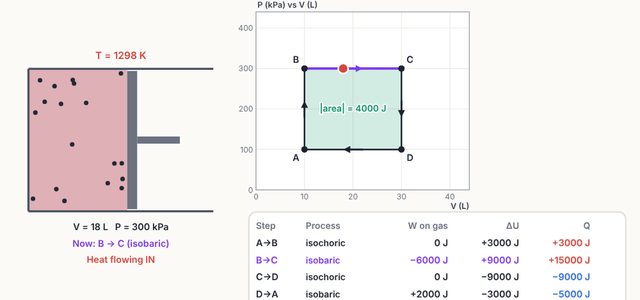
Open the Heat Engines & Cycles simulation and test every idea on this page yourself.
Open the simulation →