The big idea
A Level mechanics works in two dimensions, so the first step is nearly always to resolve into perpendicular components. A projectile has constant horizontal velocity and constant vertical acceleration. Friction opposes motion up to a limit μR, and a moment measures the turning effect of a force.
Key ideas
- Resolve a force F at angle θ into F cos θ and F sin θ.
- Projectiles: horizontal motion has no acceleration; vertical motion has a = −g. Time links the two.
- Friction is at its maximum μR when the object is moving or on the point of moving.
- On a slope, resolve parallel and perpendicular to the slope.
- Moment = force × perpendicular distance. In equilibrium, clockwise moments equal anticlockwise moments and the forces balance.
Equations
| x = (u cos θ)t, y = (u sin θ)t − (1/2)gt2 | projectile |
| Fmax = μR | limiting friction |
| moment = Fd | turning effect |
| range = u2 sin 2θ/g | on level ground |
Worked questions: easy, medium, hard
Three questions that climb in difficulty, each solved one step at a time. Try each one before you read the steps.
A 30 N weight hangs 2 m from the pivot of a light beam. What force 3 m from the pivot on the other side balances it?
- Take moments about the pivot.
- 30 × 2 = F × 3.
- F = 20 N.
A ball is projected at 20 m/s at 30° above the horizontal from level ground. Taking g = 9.8 m/s², find the time of flight, the range and the greatest height.
- Components: horizontal 20 cos 30° = 17.32 m/s, vertical 20 sin 30° = 10 m/s.
- Lands when y = 0: t = 2 × 10/9.8 = 2.04 s.
- Range = 17.32 × 2.04 = 35.3 m.
- Greatest height = 102/(2 × 9.8) = 5.10 m.
A 5 kg block slides down a rough plane inclined at 30° with coefficient of friction 0.2. Find its acceleration.
- Perpendicular to the plane: R = 5g cos 30° = 42.4 N.
- Friction = μR = 0.2 × 42.4 = 8.49 N, acting up the plane.
- Down the plane: 5g sin 30° − 8.49 = 5a, so 24.5 − 8.49 = 5a.
- a = 3.20 m/s².
Common mistakes
- Using the full speed, not a component, in a suvat equation.
- Taking R = mg on a slope.
- Measuring the distance for a moment along the beam when the force is not perpendicular to it.
Now you try: easy to hard
Six more questions, two at each level. These are the questions on the worksheet; each solution opens when you are ready.
Easy 1. Resolve a 10 N force acting at 60° to the horizontal into horizontal and vertical components.
Show the step-by-step solution
Horizontal: 10 cos 60° = 5 N. Vertical: 10 sin 60° = 8.66 N.
Easy 2. A 4 kg block rests on a rough horizontal surface with μ = 0.5. Find the maximum friction force.
Show the step-by-step solution
R = 4g = 39.2 N. F = 0.5 × 39.2 = 19.6 N.
Medium 3. A stone is thrown horizontally at 12 m/s from the top of a 20 m cliff. Find the time to reach the ground and the horizontal distance travelled.
Show the step-by-step solution
20 = 4.9t2 gives t = 2.02 s. Distance = 12 × 2.02 = 24.2 m.
Medium 4. A uniform beam AB of length 4 m and weight 100 N rests on supports at A and B. A 200 N load is placed 1 m from A. Find the two reactions.
Show the step-by-step solution
Moments about A: 4RB = 100 × 2 + 200 × 1 = 400, so RB = 100 N. Vertically: RA = 300 − 100 = 200 N.
Hard 5. A block is on the point of sliding on a plane inclined at 25°. Find the coefficient of friction.
Show the step-by-step solution
mg sin 25° = μ mg cos 25°, so μ = tan 25° = 0.466.
Hard 6. A ball projected at 45° lands 40 m away on level ground. Find its speed of projection.
Show the step-by-step solution
Range = u2 sin 90°/g, so u2 = 40 × 9.8 = 392 and u = 19.8 m/s.
6 questions to print or save, with full step-by-step answers at the end.
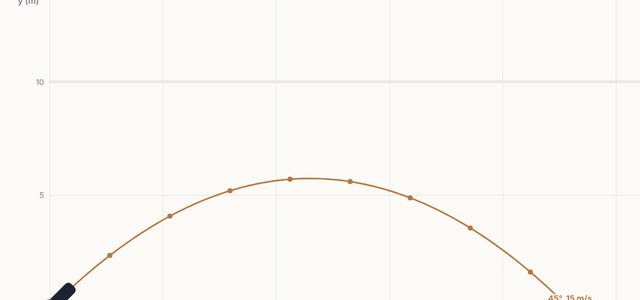
Open the Projectile Motion Lab simulation and test every idea on this page yourself.
Open the simulation →