The big idea
Rutherford's alpha-scattering experiment showed that an atom is mostly empty space with a tiny, dense, positive nucleus. Protons and neutrons are themselves made of quarks. Electrons and neutrinos are leptons, which are fundamental.
Key ideas
- Most alpha particles pass straight through gold foil; a few bounce back. So the nucleus is tiny, massive and charged.
- Every particle has an antiparticle with the same mass and opposite charge.
- Hadrons are made of quarks: baryons have three (proton = uud, neutron = udd) and mesons have a quark and an antiquark.
- Quark charges: up +⅔e, down −⅓e, strange −⅓e.
- In β⁻ decay a down quark changes to an up quark, emitting an electron and an antineutrino. Charge, baryon number and lepton number are all conserved.
Equations
| β⁻: n → p + e⁻ + ν̄ | d → u |
| β⁺: p → n + e⁺ + ν | u → d |
Worked example
Show that the quark model gives the correct charges for the proton and neutron, and that charge is conserved in β⁻ decay.
- Proton (uud): ⅔ + ⅔ − ⅓ = +1.
- Neutron (udd): ⅔ − ⅓ − ⅓ = 0.
- β⁻ decay: 0 → (+1) + (−1) + 0 ✓. Baryon number: 1 → 1 + 0 + 0 ✓. Lepton number: 0 → 0 + 1 + (−1) ✓
Common mistakes
- Calling the electron a hadron. It is a lepton, with no quarks inside.
- Forgetting the antineutrino in β⁻ decay, which is needed to conserve lepton number and energy.
Try it yourself
A meson is made of an up quark and an anti-down quark. What is its charge?
Show the answer
+⅔ + ⅓ = +1 (it is a π⁺).
Going deeper: AS Level exam level
Exam technique, a longer multi-step worked example and exam-style practice with hidden solutions.
Conservation laws and the four interactions
Every interaction conserves charge, baryon number and lepton number. Strangeness is conserved in strong interactions but can change by one in weak interactions. Hadrons feel the strong force; leptons do not. Forces are carried by exchange particles: the photon (electromagnetic), W and Z bosons (weak) and gluons (strong).
Closest approach (Edexcel and AQA)
An alpha particle fired straight at a nucleus stops when all its kinetic energy has become electric potential energy: Ek = Qq/(4πε₀r). This gives an upper limit for the size of the nucleus.
More worked examples
Example 1. A 5.0 MeV alpha particle is fired directly at a gold nucleus (Z = 79). Find the distance of closest approach.
- Ek = 5.0 × 10⁶ × 1.6 × 10⁻¹⁹ = 8.0 × 10⁻¹³ J.
- Charges: alpha 2e, gold 79e.
- r = (8.99 × 10⁹)(2 × 79)(1.6 × 10⁻¹⁹)²/(8.0 × 10⁻¹³).
- r = 4.5 × 10⁻¹⁴ m, far smaller than the atom (about 10⁻¹⁰ m).
Exam-style practice
1. What is the quark content and charge of a π⁻ meson?
Show the solution
A down quark and an anti-up quark: −⅓ − ⅔ = −1.
2. The Λ⁰ (uds) decays to a proton and a π⁻. Which interaction is responsible, and how do you know?
Show the solution
Strangeness changes from −1 to 0, so it must be the weak interaction.
Where this fits in each exam board
| Cambridge International AS & A Level (9702) | AS 11: Particle physics |
| Edexcel International A Level | Unit 4: Nuclear and particle physics (second year) |
| AQA A Level (7408) | 3.2 Particles and radiation |
4 questions to print or save, with full step-by-step answers at the end.
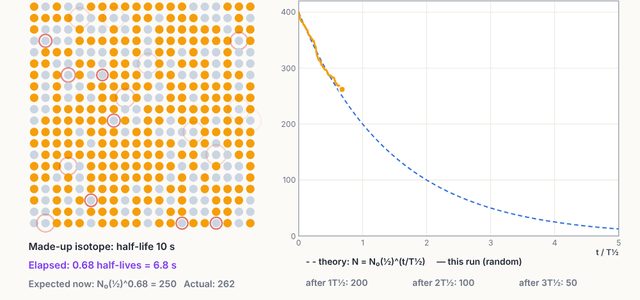
Open the Nuclear Decay & Binding Energy simulation and test every idea on this page yourself.
Open the simulation →