The big idea
A real cell has an e.m.f. (the energy it gives each coulomb) and an internal resistance that wastes some of it. Kirchhoff's laws apply conservation of charge and conservation of energy to any circuit, however complicated.
Key ideas
- Kirchhoff's first law: the total current into a junction equals the total current out (charge is conserved).
- Kirchhoff's second law: around any closed loop, the sum of the e.m.f.s equals the sum of the p.d.s (energy is conserved).
- Terminal p.d. V = E − Ir. The "lost volts" Ir grow with the current.
- A potential divider shares the supply voltage in the ratio of the resistances.
- Replacing one resistor with a thermistor or LDR makes the output voltage depend on temperature or light.
Equations
| E = I(R + r) | e.m.f. and internal resistance |
| V = E − Ir | terminal p.d. |
| 1/R = 1/R₁ + 1/R₂ | parallel |
| Vout = Vin × R₂ / (R₁ + R₂) | potential divider |
Worked example
A cell of e.m.f. 6.0 V and internal resistance 0.50 Ω is connected to a 5.5 Ω resistor. Find the current, the terminal p.d. and the power wasted in the cell.
- I = E/(R + r) = 6.0/6.0 = 1.0 A.
- V = E − Ir = 6.0 − 0.50 = 5.5 V.
- Wasted power = I²r = 0.50 W.
Common mistakes
- Using the e.m.f. as the voltage across the external resistor.
- Getting a potential divider upside down: Vout is across the resistor in the numerator.
Try it yourself
A 12 V supply is across a 2.0 kΩ and a 4.0 kΩ resistor in series. What is the p.d. across the 4.0 kΩ resistor?
Show the answer
12 × 4.0/6.0 = 8.0 V.
Going deeper: AS Level exam level
Exam technique, a longer multi-step worked example and exam-style practice with hidden solutions.
Finding e.m.f. and internal resistance
Measure the terminal p.d. V for several currents I and plot V against I. Since V = E − Ir, the graph is a straight line with y-intercept E and gradient −r. A cell delivers the most power to an external resistor when R equals r.
More worked examples
Example 1. A cell gives a terminal p.d. of 1.40 V at 0.20 A and 1.10 V at 0.80 A. Find its internal resistance and e.m.f., and the maximum power it can deliver to a load.
- r = −gradient = (1.40 − 1.10)/(0.80 − 0.20) = 0.50 Ω.
- E = V + Ir = 1.40 + 0.20 × 0.50 = 1.50 V.
- Maximum power when R = r: I = 1.50/1.00 = 1.5 A, so P = I²R = 1.5² × 0.50 = 1.1 W.
Exam-style practice
1. Two 6 Ω resistors in parallel are connected in series with a third 6 Ω resistor. Find the total resistance.
Show the solution
3 + 6 = 9 Ω.
2. A 9 V cell and a 3 V cell are connected in opposition in a loop of total resistance 4 Ω. Find the current.
Show the solution
Net e.m.f. = 6 V, so I = 6/4 = 1.5 A.
Where this fits in each exam board
| Cambridge International AS & A Level (9702) | AS 10: D.C. circuits |
| Edexcel International A Level | Unit 2: Electricity |
| AQA A Level (7408) | 3.5 Electricity |
4 questions to print or save, with full step-by-step answers at the end.
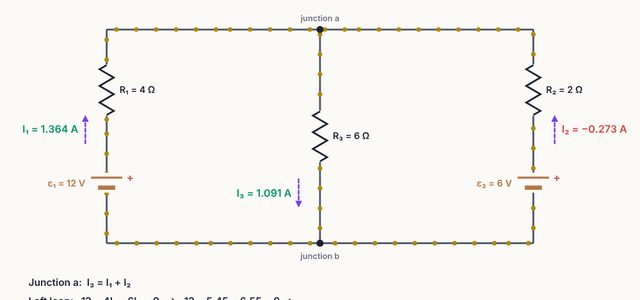
Open the Kirchhoff's Rules: Two Loops simulation and test every idea on this page yourself.
Open the simulation →