The big idea
Current is the rate of flow of charge. In a metal the charge carriers are free electrons drifting slowly through the lattice. How a component's current depends on the voltage across it, its I–V characteristic, tells you what kind of component it is.
Key ideas
- I = nAvq links the current to the number density of carriers, the cross-section, the drift velocity and the carrier charge.
- Potential difference is the energy transferred per unit charge: V = W/Q.
- Ohm's law: for a metal at constant temperature, I ∝ V. A filament lamp, a diode and a thermistor are non-ohmic.
- Resistivity ρ is a property of the material; resistance also depends on the length and area.
- A metal's resistance rises with temperature. An NTC thermistor's falls.
Equations
| Q = It | |
| I = nAvq | drift velocity |
| V = W / Q | |
| R = ρL / A | resistivity |
| P = VI = I²R = V² / R | power |
Worked example
A constantan wire (ρ = 4.9 × 10⁻⁷ Ω m) is 1.5 m long and 0.40 mm in diameter. Find its resistance.
- A = πd²/4 = π(0.40 × 10⁻³)²/4 = 1.26 × 10⁻⁷ m².
- R = ρL/A = (4.9 × 10⁻⁷)(1.5)/(1.26 × 10⁻⁷).
- R = 5.8 Ω.
Common mistakes
- Taking the gradient of a curved I–V graph as 1/R. Resistance is V/I at that point.
- Confusing resistance (of a component) with resistivity (of a material).
Try it yourself
A copper wire of cross-section 1.0 × 10⁻⁶ m² carries 2.0 A. With n = 8.5 × 10²⁸ m⁻³, find the drift velocity.
Show the answer
v = I/(nAq) = 2.0/(8.5 × 10²⁸ × 1.0 × 10⁻⁶ × 1.6 × 10⁻¹⁹) = 1.5 × 10⁻⁴ m s⁻¹.
Going deeper: AS Level exam level
Exam technique, a longer multi-step worked example and exam-style practice with hidden solutions.
Number density and three kinds of material
In I = nAvq, a metal has a huge n, so the drift velocity is tiny. A semiconductor has a much smaller n that rises with temperature, which is why a thermistor's resistance falls when it is heated. An insulator has almost no free carriers. A superconductor has zero resistivity below its critical temperature.
More worked examples
Example 1. A lamp is rated 12 V, 24 W. For normal operation find the current, the resistance, the charge that flows in 5.0 minutes, the number of electrons, and the energy transferred.
- I = P/V = 24/12 = 2.0 A; R = V/I = 6.0 Ω.
- Q = It = 2.0 × 300 = 600 C.
- Electrons = 600/1.6 × 10⁻¹⁹ = 3.8 × 10²¹.
- W = Pt = 24 × 300 = 7200 J (or QV = 600 × 12).
Exam-style practice
1. A wire is stretched to twice its length at constant volume. What happens to its resistance?
Show the solution
L doubles and A halves, so R = ρL/A becomes four times larger.
2. Why does the resistance of a metal increase with temperature?
Show the solution
The lattice ions vibrate with greater amplitude, so the electrons collide with them more often.
Where this fits in each exam board
| Cambridge International AS & A Level (9702) | AS 9: Electricity |
| Edexcel International A Level | Unit 2: Electricity |
| AQA A Level (7408) | 3.5 Electricity |
4 questions to print or save, with full step-by-step answers at the end.
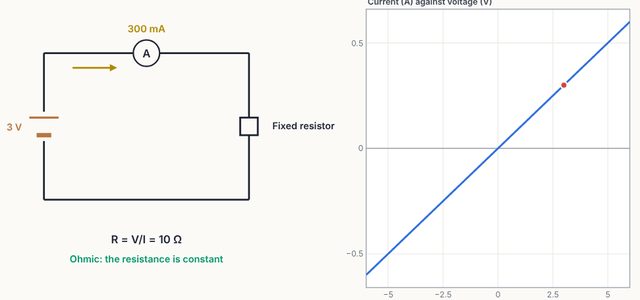
Open the I–V Characteristics & Potential Dividers simulation and test every idea on this page yourself.
Open the simulation →