The big idea
When two waves meet, the resultant displacement is the sum of their displacements. This principle of superposition explains stationary waves on strings and in pipes, the bright and dark fringes from two slits, and the sharp lines of a diffraction grating.
Key ideas
- A stationary wave forms when two identical waves travel in opposite directions. Nodes never move; antinodes have maximum amplitude. Adjacent nodes are λ/2 apart.
- Diffraction is greatest when the gap width is about one wavelength.
- Stable interference needs coherent sources: a constant phase difference.
- Path difference of nλ gives a maximum; (n + ½)λ gives a minimum.
- A grating gives bright, sharp maxima where d sin θ = nλ.
Equations
| λ = ax / D | double slit (a = slit separation, x = fringe spacing) |
| d sin θ = nλ | diffraction grating |
Worked example
In a double-slit experiment the slits are 0.50 mm apart, the screen is 2.0 m away and the fringe spacing is 2.4 mm. Find the wavelength.
- λ = ax/D = (0.50 × 10⁻³)(2.4 × 10⁻³)/2.0.
- λ = 6.0 × 10⁻⁷ m = 600 nm (orange light).
Common mistakes
- Using the grating spacing as "lines per mm". d = 1/(lines per metre).
- Measuring one fringe width. Measure across several fringes and divide, to reduce the uncertainty.
Try it yourself
A grating has 500 lines per mm. At what angle is the second-order maximum for 600 nm light?
Show the answer
d = 2.0 × 10⁻⁶ m; sin θ = 2 × 6.0 × 10⁻⁷/2.0 × 10⁻⁶ = 0.60, so θ = 37°.
Going deeper: AS Level exam level
Exam technique, a longer multi-step worked example and exam-style practice with hidden solutions.
Stationary waves on strings and in pipes
A string fixed at both ends has nodes at the ends, so L = nλ/2. A pipe closed at one end has a node at the closed end and an antinode at the open end, so L = λ/4, 3λ/4, … and only odd harmonics appear. For a stretched string (AQA): f = (1/2L)√(T/μ), where μ is the mass per unit length.
More worked examples
Example 1. A string of length 0.75 m and mass per unit length 5.0 × 10⁻⁴ kg m⁻¹ has a fundamental frequency of 220 Hz. Find the wave speed, the tension and the frequency of the third harmonic.
- Fundamental: λ = 2L = 1.5 m, so v = fλ = 220 × 1.5 = 330 m s⁻¹.
- v = √(T/μ) → T = μv² = 5.0 × 10⁻⁴ × 330² = 54 N.
- Third harmonic = 3 × 220 = 660 Hz.
Exam-style practice
1. A pipe closed at one end is 0.25 m long (v = 340 m s⁻¹). Find its two lowest resonant frequencies.
Show the solution
λ = 4L = 1.0 m: 340 Hz; the next is three times that, 1020 Hz.
2. A grating has 300 lines per mm. How many orders are visible for 600 nm light?
Show the solution
d = 3.33 × 10⁻⁶ m; n ≤ d/λ = 5.6, so 5 orders on each side.
Where this fits in each exam board
| Cambridge International AS & A Level (9702) | AS 8: Superposition |
| Edexcel International A Level | Unit 2: Waves |
| AQA A Level (7408) | 3.3 Waves |
4 questions to print or save, with full step-by-step answers at the end.
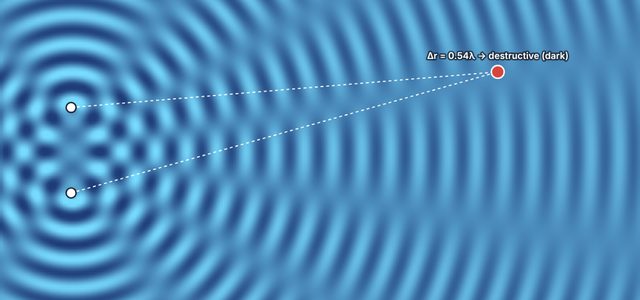
Open the Interference & Double Slit simulation and test every idea on this page yourself.
Open the simulation →