The big idea
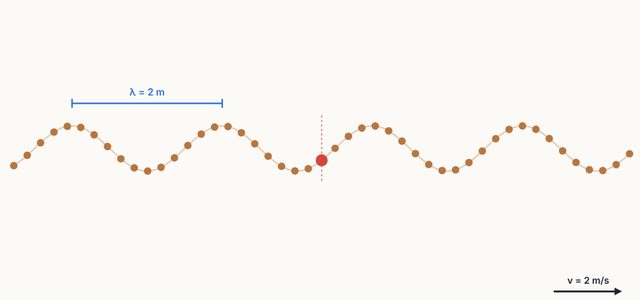
A progressive wave carries energy through a medium or through space. Points along it oscillate with the same frequency but different phase. The energy it delivers per second per square metre is its intensity.
Key ideas
- Phase difference is the fraction of a cycle by which two points (or two waves) are out of step: 360° or 2π rad is one whole cycle.
- Intensity is proportional to amplitude squared.
- For a point source, intensity falls off as 1/r² (the inverse square law).
- Only transverse waves can be polarised. Polarisation is evidence that light is transverse.
- Malus's law: a polariser at angle θ to the plane of polarisation transmits I₀ cos²θ.
Equations
| v = fλ | |
| I = P / A | intensity |
| I ∝ A² | intensity and amplitude |
| I = I₀ cos² θ | Malus's law |
Worked example
A 100 W lamp radiates equally in all directions. Find the intensity 2.0 m away. By what factor does the amplitude change at 4.0 m?
- I = P/(4πr²) = 100/(4π × 2.0²) = 2.0 W m⁻².
- Doubling the distance quarters the intensity.
- I ∝ A², so the amplitude halves.
Common mistakes
- Assuming intensity is proportional to amplitude. It is proportional to its square.
- Saying sound can be polarised. It is longitudinal.
Try it yourself
Polarised light of intensity I₀ passes through a polariser at 60° to its plane of polarisation. What intensity emerges?
Show the answer
I₀ cos² 60° = 0.25 I₀.
Going deeper: AS Level exam level
Exam technique, a longer multi-step worked example and exam-style practice with hidden solutions.
The Doppler effect
When a source of sound moves toward an observer, the waves ahead of it are squashed together, so the observed frequency is higher. Moving away, it is lower. For a source moving at speed vs (Cambridge AS): fo = fsv/(v ± vs), with the minus sign for an approaching source.
More worked examples
Example 1. An ambulance siren has a frequency of 800 Hz. The ambulance travels at 30 m s⁻¹ and sound travels at 340 m s⁻¹. Find the frequency heard as it approaches and as it moves away.
- Approaching: f = 800 × 340/(340 − 30) = 877 Hz.
- Receding: f = 800 × 340/(340 + 30) = 735 Hz.
- The pitch drops suddenly as it passes.
Exam-style practice
1. On an oscilloscope set to 0.50 ms per division, one wave is 4.0 divisions wide. Find the frequency.
Show the solution
T = 2.0 ms, so f = 1/0.0020 = 500 Hz.
2. Unpolarised light of intensity I₀ passes through one polariser, then a second at 90° to the first. What intensity emerges from each?
Show the solution
After the first: I₀/2. After the second: zero.
Where this fits in each exam board
| Cambridge International AS & A Level (9702) | AS 7: Waves |
| Edexcel International A Level | Unit 2: Waves |
| AQA A Level (7408) | 3.3 Waves |
4 questions to print or save, with full step-by-step answers at the end.
Open the Waves & Sound simulation and test every idea on this page yourself.
Open the simulation →