The big idea
To compare materials fairly, you have to remove the effect of the sample's size. Stress (force per unit area) and strain (extension per unit length) do that. Their ratio, the Young modulus, is a property of the material itself.
Key ideas
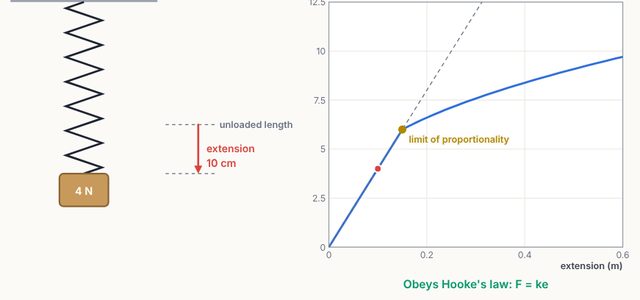
- Hooke's law holds up to the limit of proportionality. Beyond the elastic limit the material deforms permanently.
- Stress σ = F/A (Pa). Strain ε = x/L (no unit).
- Young modulus E = stress/strain: the gradient of the straight part of a stress–strain graph.
- Strain energy = area under the force–extension graph (½Fx in the linear region).
- Brittle materials snap with little plastic deformation. Ductile materials can be drawn into wires.
Equations
| F = kx | Hooke's law |
| σ = F / A | stress |
| ε = x / L | strain |
| E = σ / ε = FL / (Ax) | Young modulus |
| W = ½Fx = ½kx² | strain energy |
Worked example
A steel wire 2.0 m long and 0.50 mm in diameter stretches by 1.5 mm under a load of 30 N. Find the Young modulus.
- A = πd²/4 = π(0.50 × 10⁻³)²/4 = 1.96 × 10⁻⁷ m².
- Stress = 30/1.96 × 10⁻⁷ = 1.53 × 10⁸ Pa.
- Strain = 1.5 × 10⁻³/2.0 = 7.5 × 10⁻⁴.
- E = 1.53 × 10⁸/7.5 × 10⁻⁴ = 2.0 × 10¹¹ Pa.
Common mistakes
- Using the diameter as the radius, or forgetting to convert mm to m before squaring.
- Giving strain a unit.
Try it yourself
Two identical springs, each k = 40 N m⁻¹, are joined in series. What is the combined spring constant?
Show the answer
In series each stretches, so the total extension doubles: k = 20 N m⁻¹.
Going deeper: AS Level exam level
Exam technique, a longer multi-step worked example and exam-style practice with hidden solutions.
Measuring the Young modulus
Use a long, thin wire so the extension is large enough to measure, a micrometer for the diameter (at several places, then average), and a vernier or travelling microscope for the extension. Plot force against extension: Young modulus = gradient × L/A. For rubber, the loading and unloading curves differ; the area between them is the energy dissipated as heat (hysteresis).
More worked examples
Example 1. A force–extension graph for a wire of length 3.0 m and cross-sectional area 3.0 × 10⁻⁷ m² has a gradient of 2.0 × 10⁴ N m⁻¹. Find the Young modulus, and the strain energy when the extension is 2.0 mm.
- E = (F/x) × (L/A) = 2.0 × 10⁴ × 3.0/3.0 × 10⁻⁷.
- E = 2.0 × 10¹¹ Pa.
- Strain energy = ½kx² = ½ × 2.0 × 10⁴ × (2.0 × 10⁻³)² = 0.040 J.
Exam-style practice
1. A wire of diameter 1.0 mm has an ultimate tensile stress of 4.0 × 10⁸ Pa. What is the largest load it can support?
Show the solution
A = π(0.5 × 10⁻³)² = 7.85 × 10⁻⁷ m²; F = 4.0 × 10⁸ × 7.85 × 10⁻⁷ = 314 N.
2. Why is a long, thin wire used in a Young modulus experiment?
Show the solution
It gives a larger extension for the same load, so the percentage uncertainty in the extension is smaller.
Where this fits in each exam board
| Cambridge International AS & A Level (9702) | AS 6: Deformation of solids |
| Edexcel International A Level | Unit 1: Materials |
| AQA A Level (7408) | 3.4.2 Materials |
4 questions to print or save, with full step-by-step answers at the end.
Open the Springs & Materials simulation and test every idea on this page yourself.
Open the simulation →