The big idea
Work is done when a force moves its point of application in the direction of the force. Energy is conserved in every process, so tracking where it goes is one of the most powerful ways to solve a problem.
Key ideas
- Work done = Fs cos θ, where θ is the angle between the force and the displacement.
- The kinetic energy formula follows from v² = u² + 2as and W = Fs.
- For a moving vehicle, power = driving force × velocity. At top speed, the driving force equals the resistive forces.
- Efficiency = useful output ÷ total input, for energy or for power.
Equations
| W = Fs cos θ | work |
| Ek = ½mv² | |
| ΔEp = mgΔh | |
| P = W / t = Fv | power |
Worked example
A car travels at a steady 25 m s⁻¹ against resistive forces of 800 N. Find the useful power of the engine. If the engine is 25% efficient, at what rate is fuel energy supplied?
- Steady speed, so driving force = 800 N.
- P = Fv = 800 × 25 = 20 kW.
- Input power = 20/0.25 = 80 kW.
Common mistakes
- Forgetting cos θ when the force is not along the motion.
- Using P = Fv with the resultant force. Use the force the engine provides.
Try it yourself
A 0.50 kg ball is dropped from 12 m and lands at 14 m s⁻¹. How much energy was transferred to the air?
Show the answer
mgh = 58.9 J; ½mv² = 49.0 J; so 9.9 J was transferred by air resistance.
Going deeper: AS Level exam level
Exam technique, a longer multi-step worked example and exam-style practice with hidden solutions.
Power on a slope
At steady speed up a hill, the engine does work against gravity and against resistive forces. Find the rate of gain of potential energy (mg × vertical speed) and add the power used against resistance (Fv). When efficiencies are chained, multiply them.
More worked examples
Example 1. A 1200 kg car climbs a hill at a steady 15 m s⁻¹, rising 30 m vertically for every 400 m of road. Resistive forces total 500 N. Find the useful power output of the engine.
- Time for 400 m: 400/15 = 26.7 s.
- Gain in Ep: 1200 × 9.81 × 30 = 353 000 J, a rate of 353 000/26.7 = 13.2 kW.
- Against resistance: Fv = 500 × 15 = 7.5 kW.
- Total = 20.7 kW.
Exam-style practice
1. A pump raises 600 kg of water through 8.0 m each minute and is 60% efficient. Find the input power.
Show the solution
Useful power = 600 × 9.81 × 8.0/60 = 785 W; input = 785/0.60 = 1.3 kW.
2. A 900 kg car travelling at 20 m s⁻¹ is brought to rest in 40 m. Find the average braking force.
Show the solution
Work done = KE: F × 40 = ½ × 900 × 400, so F = 4500 N.
Where this fits in each exam board
| Cambridge International AS & A Level (9702) | AS 5: Work, energy and power |
| Edexcel International A Level | Unit 1: Mechanics |
| AQA A Level (7408) | 3.4.1 Force, energy and momentum |
4 questions to print or save, with full step-by-step answers at the end.
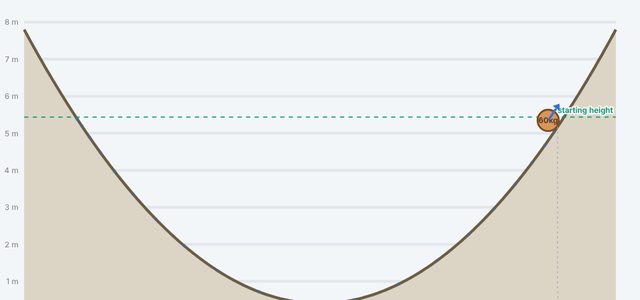
Open the Energy Skate Track simulation and test every idea on this page yourself.
Open the simulation →