The big idea
An object is in equilibrium when the resultant force on it is zero and the resultant moment about any point is zero. Problems are solved by resolving forces in two perpendicular directions and by taking moments about a well-chosen point.
Key ideas
- Three forces in equilibrium form a closed triangle of forces when drawn tip to tail.
- The moment of a force = force × perpendicular distance from the pivot to its line of action.
- A couple is a pair of equal, opposite, parallel forces. Its torque = one force × the perpendicular distance between them.
- Take moments about a point where an unknown force acts to remove it from the equation.
- Upthrust equals the weight of fluid displaced (Archimedes' principle). Pressure in a fluid: Δp = ρgΔh.
Equations
| ΣF = 0 and Σ moments = 0 | equilibrium |
| moment = Fd | |
| torque of a couple = Fd | |
| Δp = ρgΔh |
Worked example
A uniform 4.0 m beam of weight 200 N rests on supports at each end. A 600 N load hangs 1.0 m from the left end. Find the force from each support.
- Take moments about the left support: R × 4.0 = 200 × 2.0 + 600 × 1.0 = 1000 N m.
- Right support: R = 250 N.
- Vertical forces: L + 250 = 800, so the left support gives 550 N.
Structured problems with diagrams
Longer problems solved one decision at a time: draw the diagram, find each force or field, resolve it into components, then add.
Problem 1. Three forces in equilibrium at different angles
A 50 N lamp hangs from two cables attached to a ceiling. The left cable makes 30° with the horizontal and the right cable makes 45° with the horizontal. Find the tension in each cable.
- ConditionThe junction is at rest, so the resultant force is zero in both the horizontal and vertical directions.
- Resolve horizontallyT₁ cos 30° = T₂ cos 45° → 0.866 T₁ = 0.707 T₂, so T₂ = 1.225 T₁.
- Resolve verticallyT₁ sin 30° + T₂ sin 45° = 50 → 0.500 T₁ + 0.707 T₂ = 50.
- Substitute0.500 T₁ + 0.707(1.225 T₁) = 1.366 T₁ = 50, so T₁ = 36.6 N.
- Second tensionT₂ = 1.225 × 36.6 = 44.8 N.
- Check with a triangle of forcesThe three forces form a closed triangle with angles 45°, 60° and 75°. Sine rule: T₁/sin 45° = 50/sin 75° gives T₁ = 36.6 N ✓. The steeper cable carries more of the weight.
Common mistakes
- Leaving out the weight of a uniform beam, which acts at its centre.
- Using the distance along a sloping beam instead of the perpendicular distance.
Try it yourself
Two equal and opposite 12 N forces act on the rim of a wheel of diameter 0.40 m. Find the torque of the couple.
Show the answer
12 × 0.40 = 4.8 N m.
Going deeper: AS Level exam level
Exam technique, a longer multi-step worked example and exam-style practice with hidden solutions.
Fluids: upthrust and Stokes' law
An object in a fluid feels an upthrust equal to the weight of fluid displaced, ρfluidVg. A small sphere moving slowly through a viscous fluid also feels a drag F = 6πηrv (Stokes' law, needed for Edexcel). At terminal velocity: weight = upthrust + drag.
More worked examples
Example 1. A steel ball of radius 1.0 mm (density 7800 kg m⁻³) falls through glycerol (density 1260 kg m⁻³, viscosity 1.5 Pa s). Find its terminal velocity.
- Balance: (4/3)πr³ρsg = (4/3)πr³ρfg + 6πηrv.
- Rearranged: v = 2r²g(ρs − ρf)/(9η).
- v = 2 × (1.0 × 10⁻³)² × 9.81 × (7800 − 1260)/(9 × 1.5).
- v = 9.5 × 10⁻³ m s⁻¹ (about 1 cm per second).
Exam-style practice
1. What fraction of an iceberg (917 kg m⁻³) is below the surface of sea water (1025 kg m⁻³)?
Show the solution
Floating: weight = upthrust, so the fraction = 917/1025 = 0.89.
2. Find the upthrust on a 2.0 × 10⁻³ m³ block fully under water.
Show the solution
ρVg = 1000 × 2.0 × 10⁻³ × 9.81 = 19.6 N.
Where this fits in each exam board
| Cambridge International AS & A Level (9702) | AS 4: Forces, density and pressure |
| Edexcel International A Level | Unit 1: Mechanics and Materials |
| AQA A Level (7408) | 3.4.1 Force, energy and momentum |
4 questions to print or save, with full step-by-step answers at the end.
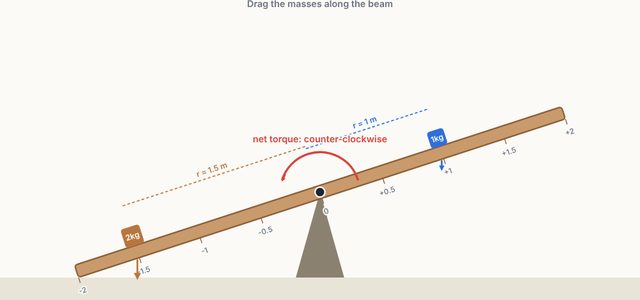
Open the Torque & Balance simulation and test every idea on this page yourself.
Open the simulation →