The big idea
Newton's second law in its full form says that the resultant force equals the rate of change of momentum. F = ma is the special case for constant mass. Momentum is conserved in every interaction between objects when no external force acts.
Key ideas
- Impulse = FΔt = change in momentum = area under a force–time graph.
- Momentum is always conserved in a closed system. Kinetic energy is conserved only in perfectly elastic collisions.
- In a perfectly elastic collision, relative speed of approach = relative speed of separation.
- Newton's third law pairs are the same type of force and act on different bodies.
Equations
| F = Δp / Δt | Newton's second law |
| p = mv | |
| FΔt = Δ(mv) | impulse |
Worked example
A 0.16 kg ball travelling at 30 m s⁻¹ is hit straight back at 20 m s⁻¹. The contact lasts 4.0 ms. Find the average force on the ball.
- Take the final direction as positive: u = −30, v = +20 m s⁻¹.
- Δp = 0.16 × (20 − (−30)) = 8.0 kg m s⁻¹.
- F = Δp/Δt = 8.0/0.0040 = 2000 N.
Common mistakes
- Subtracting the speeds (30 − 20) when the direction reverses. The velocity change is 50 m s⁻¹.
- Assuming kinetic energy is conserved in every collision.
Try it yourself
A 3.0 kg trolley at 4.0 m s⁻¹ collides with a 1.0 kg trolley at rest and they join. Find the common speed and the kinetic energy lost.
Show the answer
v = 12/4.0 = 3.0 m s⁻¹. KE before = 24 J, after = 18 J: 6 J lost.
Going deeper: AS Level exam level
Exam technique, a longer multi-step worked example and exam-style practice with hidden solutions.
Free-body diagrams and elastic collisions
For any accelerating object, draw the forces on that object only and apply F = ma along the direction of motion. For a perfectly elastic head-on collision you have two equations: conservation of momentum, and relative speed of approach = relative speed of separation. Together they avoid a quadratic.
More worked examples
Example 1. A 2.0 kg trolley moving at 3.0 m s⁻¹ collides elastically, head-on, with a stationary 1.0 kg trolley. Find both velocities afterwards and check the kinetic energy.
- Momentum: 2.0 × 3.0 = 2.0v₁ + 1.0v₂ → 6.0 = 2v₁ + v₂.
- Elastic: speed of separation = speed of approach → v₂ − v₁ = 3.0.
- Solving: v₁ = 1.0 m s⁻¹, v₂ = 4.0 m s⁻¹.
- KE before = ½ × 2.0 × 9 = 9.0 J. After: 1.0 + 8.0 = 9.0 J ✓
Exam-style practice
1. A lift of mass 500 kg accelerates upward at 1.5 m s⁻². Find the tension in its cable.
Show the solution
T − mg = ma, so T = 500(9.81 + 1.5) = 5660 N.
2. A rocket ejects 2.0 kg of gas each second at 500 m s⁻¹. Find the thrust.
Show the solution
F = Δp/Δt = 2.0 × 500 = 1000 N.
Where this fits in each exam board
| Cambridge International AS & A Level (9702) | AS 3: Dynamics |
| Edexcel International A Level | Unit 1: Mechanics |
| AQA A Level (7408) | 3.4.1 Force, energy and momentum |
4 questions to print or save, with full step-by-step answers at the end.
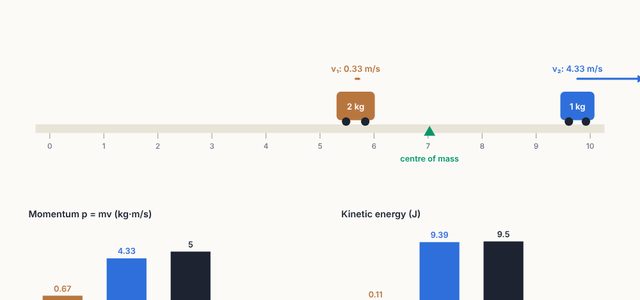
Open the Collisions & Momentum simulation and test every idea on this page yourself.
Open the simulation →