The big idea
For constant acceleration, four equations (often called suvat) link displacement, initial and final velocity, acceleration and time. A projectile is two such motions at once: constant velocity horizontally, and constant acceleration g vertically.
Key ideas
- Choose a positive direction and stick to it. Upward launch with up positive means a = −9.81 m s⁻².
- Gradient of displacement–time = velocity. Gradient of velocity–time = acceleration. Area under velocity–time = displacement.
- Horizontal and vertical motions are independent: the only quantity they share is time.
- At the top of a projectile's path the vertical velocity is zero, but the horizontal velocity is unchanged.
Equations
| v = u + at | |
| s = ut + ½at² | |
| v² = u² + 2as | |
| s = ½(u + v)t |
Worked example
A ball is kicked from level ground at 20 m s⁻¹ at 30° above the horizontal. Find its time of flight, range and maximum height.
- Components: ux = 20 cos 30° = 17.3 m s⁻¹; uy = 20 sin 30° = 10.0 m s⁻¹.
- Vertical, back to the ground (s = 0): 0 = 10.0t − ½(9.81)t² → t = 2.04 s.
- Range = uxt = 17.3 × 2.04 = 35.3 m.
- Maximum height: 0 = 10.0² − 2(9.81)h → h = 5.10 m.
Common mistakes
- Using the full launch speed in the vertical equations instead of the vertical component.
- Giving the acceleration at the top of the flight as zero. It is still g downward.
Try it yourself
A stone is dropped from a cliff and hits the sea 3.0 s later. How high is the cliff?
Show the answer
s = ½ × 9.81 × 3.0² = 44 m.
Going deeper: AS Level exam level
Exam technique, a longer multi-step worked example and exam-style practice with hidden solutions.
Projectiles launched from a height
Treat the two directions separately and link them with time. The vertical motion alone decides the time of flight. The final velocity is found by combining the unchanged horizontal component with the final vertical component, using Pythagoras for the size and tan for the direction.
More worked examples
Example 1. A stone is thrown horizontally at 12 m s⁻¹ from the top of a 45 m cliff. Find the time to reach the sea, how far from the cliff it lands, and its velocity on impact.
- Vertical: s = ½gt² → t = √(2 × 45/9.81) = 3.03 s.
- Horizontal: x = 12 × 3.03 = 36 m.
- Vertical velocity: v = gt = 29.7 m s⁻¹.
- Speed = √(12² + 29.7²) = 32 m s⁻¹, at tan⁻¹(29.7/12) = 68° below the horizontal.
Exam-style practice
1. A ball is thrown vertically upward at 15 m s⁻¹. Find the maximum height and the time to reach it.
Show the solution
h = u²/2g = 225/19.62 = 11.5 m; t = u/g = 1.53 s.
2. A car accelerates from rest at 2.0 m s⁻² for 5.0 s, then travels at constant speed for 10 s. Find the total distance.
Show the solution
½ × 2.0 × 25 = 25 m, then 10 × 10 = 100 m: 125 m.
Where this fits in each exam board
| Cambridge International AS & A Level (9702) | AS 2: Kinematics |
| Edexcel International A Level | Unit 1: Mechanics |
| AQA A Level (7408) | 3.4.1 Force, energy and momentum |
4 questions to print or save, with full step-by-step answers at the end.
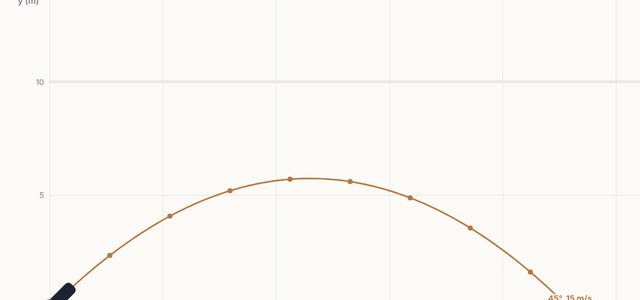
Open the Projectile Motion Lab simulation and test every idea on this page yourself.
Open the simulation →