The big idea
Every physical quantity is a number with a unit. All units can be built from the SI base units, and a correct equation must have the same units on both sides. Every measurement also has an uncertainty, and you need to know how uncertainties combine.
Key ideas
- Base units: kg, m, s, A, K, mol. A newton is kg m s⁻², a joule is kg m² s⁻².
- Prefixes: p (10⁻¹²), n (10⁻⁹), µ (10⁻⁶), m (10⁻³), k (10³), M (10⁶), G (10⁹).
- Systematic errors shift every reading the same way (affecting accuracy). Random errors scatter readings (affecting precision).
- When adding or subtracting, add absolute uncertainties. When multiplying or dividing, add percentage uncertainties. For a power, multiply the percentage by the power.
- A vector is resolved into perpendicular components F cos θ and F sin θ.
Equations
| % uncertainty = (Δx / x) × 100 | |
| Fx = F cos θ, Fy = F sin θ | components |
Worked example
A sample has mass 45.0 ± 0.5 g and volume 5.0 ± 0.2 cm³. Find its density with its uncertainty.
- ρ = m/V = 45.0/5.0 = 9.0 g cm⁻³.
- Percentage uncertainties: mass 0.5/45.0 = 1.1%; volume 0.2/5.0 = 4.0%.
- Dividing, so add them: 5.1%. Absolute: 0.051 × 9.0 = 0.46.
- ρ = 9.0 ± 0.5 g cm⁻³.
Common mistakes
- Adding absolute uncertainties when multiplying.
- Quoting an uncertainty to more than one or two significant figures.
Try it yourself
Show that the unit of pressure, the pascal, is kg m⁻¹ s⁻² in base units.
Show the answer
p = F/A: (kg m s⁻²)/(m²) = kg m⁻¹ s⁻².
Going deeper: AS Level exam level
Exam technique, a longer multi-step worked example and exam-style practice with hidden solutions.
Combining uncertainties in a real experiment
Write the equation with the quantity you want as the subject, then add the percentage uncertainties, multiplying by the power for anything squared or rooted. For a straight-line graph, the uncertainty in the gradient comes from the steepest and shallowest lines that still pass through the error bars. Quote the final uncertainty to one significant figure and round the value to match.
More worked examples
Example 1. A pendulum of length 0.800 ± 0.002 m has a period of 1.79 ± 0.01 s. Use T = 2π√(l/g) to find g with its uncertainty.
- g = 4π²l/T² = 4π² × 0.800/1.79² = 9.86 m s⁻².
- Percentage uncertainties: l: 0.002/0.800 = 0.25%; T: 0.01/1.79 = 0.56%.
- T is squared, so total = 0.25 + 2 × 0.56 = 1.4%.
- Absolute: 0.014 × 9.86 = 0.14, so g = 9.9 ± 0.1 m s⁻².
Exam-style practice
1. Estimate the kinetic energy of a sprinter.
Show the solution
Take m ≈ 80 kg and v ≈ 10 m s⁻¹: ½ × 80 × 10² ≈ 4000 J.
2. Show that v² = 2as is homogeneous.
Show the solution
Left: (m s⁻¹)² = m² s⁻². Right: (m s⁻²)(m) = m² s⁻². ✓
Where this fits in each exam board
| Cambridge International AS & A Level (9702) | AS 1: Physical quantities and units |
| Edexcel International A Level | Unit 1, and practical skills throughout |
| AQA A Level (7408) | 3.1 Measurements and their errors |
4 questions to print or save, with full step-by-step answers at the end.
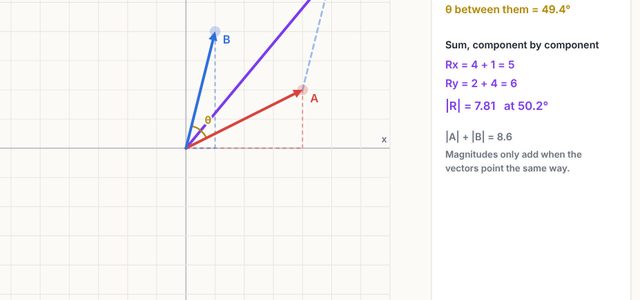
Open the Vectors: Add, Dot & Cross simulation and test every idea on this page yourself.
Open the simulation →