The big idea
Electrons in atoms can only have certain discrete energies. When an electron drops to a lower level it emits a photon carrying exactly the energy difference. That's why heated gases glow with sharp, separate colours, and why each element has its own spectral "fingerprint".
Key ideas
- Hydrogen: En = −13.6 eV/n². The ground state is n = 1, and 0 eV means ionized.
- Emission: the electron drops and emits a photon with E = |ΔE|. Absorption: a photon with exactly |ΔE| raises the electron.
- λ = hc/|ΔE| = 1240/|ΔE| nm.
- Series: drops to n = 1 (Lyman) are UV, drops to n = 2 (Balmer) are visible, drops to n = 3 (Paschen) are IR.
- Absorption spectra show dark lines at exactly the wavelengths of the emission lines.
Equations
| En = −13.6 eV/n² | hydrogen energy levels |
| Ephoton = |Ei − Ef| | transition energy |
| λ = 1240/|ΔE| nm | with ΔE in eV |
| E = hf | photon energy |
Worked example
An electron in hydrogen drops from n = 3 to n = 2. Find the photon energy and wavelength, and name the colour.
- E₃ = −13.6/9 = −1.51 eV; E₂ = −13.6/4 = −3.40 eV.
- ΔE = 3.40 − 1.51 = 1.89 eV.
- λ = 1240/1.89 = 656 nm.
- That's red, the famous H-alpha line in the Balmer series.
Answer: 1.89 eV, 656 nm (red, Balmer H-α)
Common mistakes
- Forgetting that the energies are negative, then getting the sign of ΔE wrong.
- Thinking an atom can absorb any photon. The energy has to match a gap exactly (unless it ionizes the atom).
- Calling all hydrogen lines visible. Most are UV or IR.
Try it yourself
Find the wavelength of the photon emitted in the n = 2 → 1 transition.
Show the answer
ΔE = 13.6(1 − ¼) = 10.2 eV; λ = 1240/10.2 ≈ 122 nm (ultraviolet, Lyman series).
See it in action
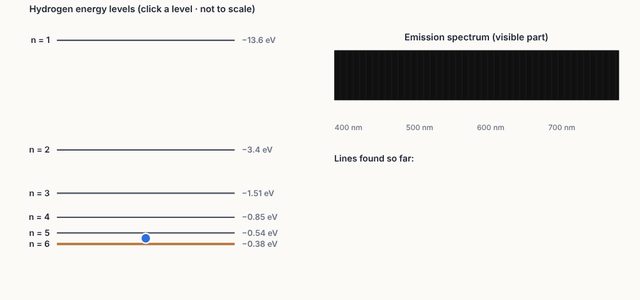
Open the Energy Levels & Spectra simulation and test every idea on this page yourself.
Open the simulation →