The big idea
Shine light on a metal and electrons can be knocked out, but only if the light's frequency is high enough, however bright it is. The wave model couldn't explain this. Einstein could: light arrives in photons of energy hf, and each photon gives all its energy to a single electron.
Key ideas
- Photon energy E = hf = hc/λ. A handy form is E (eV) = 1240/λ (nm).
- An electron escapes only if hf ≥ φ (the work function). Below the threshold frequency there is no emission at any intensity.
- Kmax = hf − φ. On a graph of Kmax against f, the slope is h and the x-intercept is the threshold f₀.
- Intensity controls the number of photons, and so the current. Frequency controls the energy of each photon, and so Kmax.
- The stopping voltage measures Kmax: eVs = Kmax.
Equations
| E = hf = hc/λ | photon energy |
| Kmax = hf − φ | photoelectric equation |
| f₀ = φ/h | threshold frequency |
| eVs = Kmax | stopping voltage |
| hc = 1240 eV·nm | useful constant |
Worked example
400 nm light shines on sodium (φ = 2.28 eV). Find the photon energy, Kmax, the stopping voltage, and the threshold wavelength.
- E = 1240/400 = 3.10 eV.
- Kmax = 3.10 − 2.28 = 0.82 eV.
- Vs = Kmax/e = 0.82 V.
- Threshold: λ₀ = 1240/2.28 = 544 nm (green). Longer, redder light frees no electrons at all.
Answer: E = 3.10 eV, Kmax = 0.82 eV, Vs = 0.82 V, λ₀ = 544 nm
Common mistakes
- Saying brighter light gives faster electrons. It gives more electrons.
- Using wavelength where frequency is needed, or the reverse, without converting.
- Forgetting that Kmax is the maximum. Many electrons come out slower.
Try it yourself
Will 300 nm light free electrons from zinc (φ = 4.3 eV)?
Show the answer
E = 1240/300 = 4.13 eV < 4.3 eV, so no emission, however bright the light.
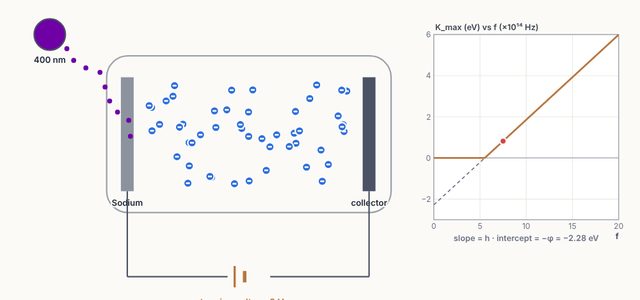
See it in action
Open the Photoelectric Effect simulation and test every idea on this page yourself.
Open the simulation →