The big idea
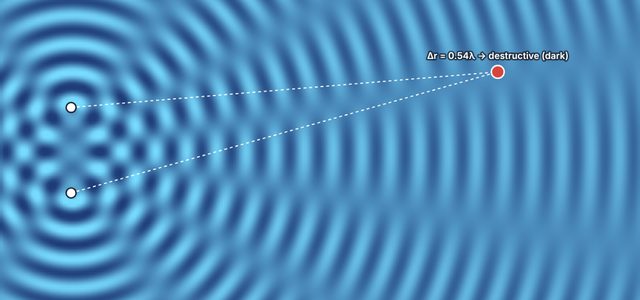
When two waves overlap, their displacements add. Crest on crest gives bright light or loud sound (constructive), and crest on trough gives darkness or silence (destructive). Young's double-slit experiment used this to prove that light is a wave.
Key ideas
- Constructive interference: path difference = mλ. Destructive: (m + ½)λ.
- Double slit: bright fringes where d sin θ = mλ. For small angles, ym = mλL/d.
- Fringe spacing Δy = λL/d: longer λ or a bigger L spreads the fringes, and a bigger d squeezes them.
- A diffraction grating (many slits) obeys the same d sin θ = mλ, with much sharper, brighter maxima.
- Each slit's finite width a adds a single-slit diffraction envelope (dark at a sin θ = mλ).
Equations
| Δr = mλ | constructive |
| Δr = (m + ½)λ | destructive |
| d sin θ = mλ | double slit / grating maxima |
| Δy = λL/d | fringe spacing (small angles) |
| a sin θ = mλ | single-slit minima |
Worked example
Green light (λ = 550 nm) passes through two slits 0.20 mm apart onto a screen 1.5 m away. Find the fringe spacing.
- Δy = λL/d = (550 × 10⁻⁹)(1.5)/(0.20 × 10⁻³).
- Δy = 4.1 × 10⁻³ m = 4.1 mm.
- Check the small-angle assumption: θ ≈ Δy/L = 0.0027 rad. That's tiny ✓
- Red light (longer λ) would spread the fringes further apart.
Answer: Δy ≈ 4.1 mm
Common mistakes
- Mixing up d (the spacing between slits) with a (the width of each slit).
- Forgetting to convert nm and mm into metres.
- Using y = mλL/d at large angles, where you need d sin θ = mλ.
Try it yourself
A grating has 600 lines per mm. At what angle is the first-order maximum for 500 nm light?
Show the answer
d = 1/600 mm = 1.67 µm; sin θ = λ/d = 0.30 → θ ≈ 17°.
See it in action
Open the Interference & Double Slit simulation and test every idea on this page yourself.
Open the simulation →