The big idea
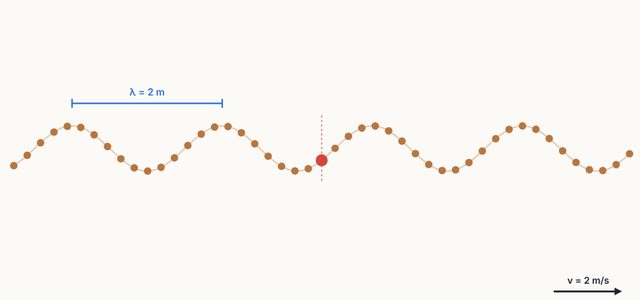
A wave carries energy from one place to another without carrying matter. Every wave obeys v = fλ. When waves reflect and interfere with themselves, only certain wavelengths "fit", and those make the standing waves of guitar strings and organ pipes.
Key ideas
- Transverse waves: the medium moves perpendicular to the wave (strings, light). Longitudinal: parallel to it (sound).
- The medium sets the wave speed. Changing f changes λ, not v.
- A string fixed at both ends has nodes at both ends: λn = 2L/n, fn = nv/(2L), and every n is allowed.
- A pipe open at both ends has antinodes at both ends, with the same pattern as a string.
- A pipe closed at one end: fn = nv/(4L) with odd n only.
Equations
| v = fλ | wave speed |
| T = 1/f | period |
| fn = nv/(2L) | string, or pipe open at both ends |
| fn = nv/(4L), n odd | pipe closed at one end |
| vsound ≈ 343 m/s | speed of sound in air at 20 °C |
Worked example
A 1.2 m string has a wave speed of 120 m/s. Find its fundamental and third harmonic. Then find the fundamental of a 0.80 m pipe that is (a) open at both ends and (b) closed at one end.
- String: f₁ = v/(2L) = 120/2.4 = 50 Hz; f₃ = 3f₁ = 150 Hz.
- Open pipe: f₁ = 343/(2 × 0.80) = 214 Hz.
- Closed pipe: f₁ = 343/(4 × 0.80) = 107 Hz, an octave lower.
- The closed pipe's next resonance is 3f₁ = 322 Hz, because only odd harmonics are allowed.
Answer: String: 50 Hz, 150 Hz · open pipe 214 Hz · closed pipe 107 Hz
Common mistakes
- Thinking a higher frequency travels faster.
- Using even harmonics for a pipe closed at one end.
- Mixing up displacement nodes and pressure nodes in pipes.
Try it yourself
A wave has f = 5.0 Hz and λ = 0.40 m. What is its speed?
Show the answer
v = fλ = (5.0)(0.40) = 2.0 m/s.
See it in action
Open the Waves & Sound simulation and test every idea on this page yourself.
Open the simulation →