The big idea
Light travels in straight lines until it meets a new material or a surface. At a boundary it bends (refraction) or bounces (reflection). Curved lenses and mirrors use these effects to form images, and three principal rays, or one equation, tell you where.
Key ideas
- Reflection: the angle of incidence equals the angle of reflection.
- Refraction: n₁ sin θ₁ = n₂ sin θ₂. Light bends toward the normal when it slows down (enters a higher n).
- Total internal reflection happens going from high n to low n, beyond the critical angle sin θc = n₂/n₁.
- The same equation, 1/do + 1/di = 1/f, works for lenses and mirrors. With the AP sign convention, a positive di means a real image.
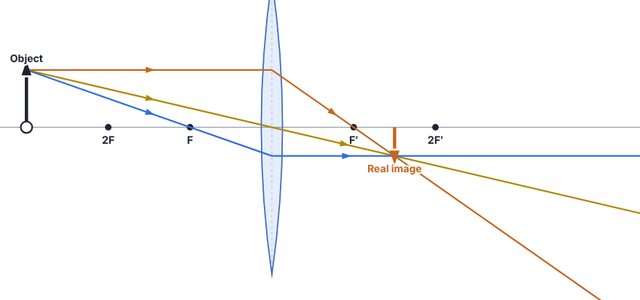
- Converging lenses and concave mirrors (f > 0) form real, inverted images beyond F, and virtual, upright, enlarged images inside F. Diverging elements always form virtual, upright, reduced images.
Equations
| n = c/v | index of refraction |
| n₁ sin θ₁ = n₂ sin θ₂ | Snell's law |
| 1/do + 1/di = 1/f | thin lens / mirror equation |
| m = −di/do = hi/ho | magnification |
| f = R/2 | spherical mirror |
Worked example
An object is 30 cm from a converging lens with f = 10 cm. Locate and describe the image. Then repeat with the object 5.0 cm from the lens.
- 1/di = 1/10 − 1/30 = 2/30 → di = +15 cm (real, on the far side).
- m = −15/30 = −0.50: inverted and half size. This is how a camera works.
- Object at 5.0 cm: 1/di = 1/10 − 1/5 = −1/10 → di = −10 cm (virtual, same side as the object).
- m = −(−10)/5 = +2.0: upright and twice the size. This is a magnifying glass.
Answer: 30 cm → real, inverted, ×0.5 at 15 cm; 5 cm → virtual, upright, ×2 at −10 cm
Common mistakes
- Dropping the sign of di and calling a virtual image real.
- Bending the light the wrong way at a boundary (toward the normal when entering a higher n).
- Thinking covering half a lens removes half the image. You still see the whole image, only dimmer.
Try it yourself
Light passes from water (n = 1.33) into air at 30° to the normal. Find the refraction angle and the critical angle.
Show the answer
sin θ₂ = 1.33 sin 30° = 0.665 → θ₂ ≈ 42°; critical angle = sin⁻¹(1/1.33) ≈ 49°.
See it in action
Open the Ray Diagram Lab simulation and test every idea on this page yourself.
Open the simulation →