The big idea
A changing magnetic flux through a loop induces an emf, which is how generators, transformers and induction cooktops work. Faraday's law gives the size. Lenz's law gives the direction: the induced current always opposes the change that caused it.
Key ideas
- Magnetic flux Φ = BA cos θ. It changes when B, the area A, or the angle changes.
- Faraday: ε = −N dΦ/dt. No change in flux means no emf, however strong B is.
- Lenz: the induced current makes its own field to oppose the change in flux. That's energy conservation at work.
- Motional emf: a rod moving through a field gives ε = BLv, and the induced current produces a force that opposes the motion.
- Inductors (C: E&M) oppose changes in current: VL = L dI/dt, and in an LR circuit τ = L/R.
Equations
| Φ = BA cos θ | magnetic flux |
| ε = −N dΦ/dt | Faraday's law |
| ε = BLv | motional emf |
| I(t) = (ε/R)(1 − e−t/τ), τ = L/R | LR circuit (C: E&M) |
| U = ½LI² | energy in an inductor |
Worked example
A 0.50 m rod slides at 2.0 m/s along rails in a 0.80 T field (perpendicular). The circuit resistance is 2.0 Ω. Find the emf, the current, and the magnetic force on the rod.
- ε = BLv = (0.80)(0.50)(2.0) = 0.80 V.
- I = ε/R = 0.80/2.0 = 0.40 A.
- F = ILB = (0.40)(0.50)(0.80) = 0.16 N, opposing the motion (Lenz).
- To keep the rod moving at constant speed, you must push with 0.16 N. Your power Fv = 0.32 W equals I²R, the heat produced in the resistor.
Common mistakes
- Thinking a strong field alone induces an emf. The flux has to change.
- Getting Lenz's law backwards: the current opposes the change in flux, not the flux itself.
- Forgetting N, the number of turns, in a coil.
Try it yourself
A 50-turn coil of area 0.010 m² sits in a field that rises from 0 to 0.40 T in 0.20 s. Find the average emf.
Show the answer
ε = NΔΦ/Δt = 50(0.40 × 0.010)/0.20 = 1.0 V.
Going deeper: AP Physics C
This part goes beyond the algebra course: calculus derivations, harder multi-step problems and exam-style practice, written at the level of the AP Physics C exam.
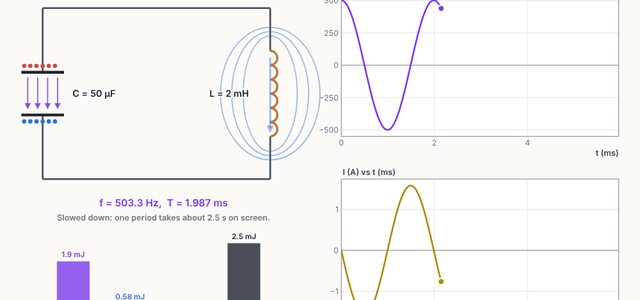 Simulation for this sectionLC OscillationsOpen it →
Flux and motional EMF
ΦB = ∫B·dA, and Faraday's law is ε = −N dΦB/dt. A rod of length L sliding at speed v across a field B sweeps out area, which gives ε = BLv. With a resistance R in the circuit, the current I = BLv/R feels a retarding force BIL = B²L²v/R. Pulling the rod at constant speed takes exactly as much power as the resistor dissipates.
Generators and induced electric fields
A coil rotating at ω in a uniform field: ε = NBAω sin ωt. A changing magnetic field creates a non-conservative electric field whose loops close on themselves:
∮E·dℓ = −dΦBdtInside a solenoid whose field is changing, E = (r/2)(dB/dt).
Inductance, RL and LC circuits
An inductor opposes changes in current: ε = −L dI/dt. For a solenoid, L = μ₀n²Aℓ. It stores energy U = ½LI², with energy density u = B²/(2μ₀). In an RL circuit the current grows as I = (ε/R)(1 − e−t/τ) with τ = L/R. An inductor acts like a break at first and like a wire later, the opposite of a capacitor. In an LC circuit, energy sloshes between the capacitor and the inductor at ω = 1/√(LC), the electrical version of a mass on a spring.
Maxwell's equations
The four laws of the C course, all together:
- Gauss (E): ∮E·dA = Qenc/ε₀
- Gauss (B): ∮B·dA = 0, so there are no magnetic monopoles
- Faraday: ∮E·dℓ = −dΦB/dt
- Ampère–Maxwell: ∮B·dℓ = μ₀Ienc + μ₀ε₀ dΦE/dt
More worked examples
Example 1. A 100-turn coil of area 0.020 m² spins at 60 Hz in a 0.50 T field. Find its peak EMF.
- ω = 2π(60) = 377 rad/s.
- εmax = NBAω = (100)(0.50)(0.020)(377) = 377 V.
Example 2. A solenoid has n = 2000 turns/m, radius 2.0 cm and length 0.30 m. Find its inductance, and the energy stored when it carries 0.30 A.
- L = μ₀n²Aℓ = (4π × 10⁻⁷)(2000)²(π(0.020)²)(0.30) = 1.9 mH.
- U = ½LI² = ½(1.9 × 10⁻³)(0.09) = 85 µJ.
Example 3. An LC circuit has L = 2.0 mH and C = 50 µF. The capacitor starts charged to 10 V. Find the oscillation frequency and the maximum current.
- ω = 1/√(LC) = 1/√(1.0 × 10⁻⁷) = 3162 rad/s → f = ω/2π = 503 Hz.
- q₀ = CV = 0.50 mC. Energy: q₀²/(2C) = ½LImax² → Imax = ωq₀.
- Imax = (3162)(5.0 × 10⁻⁴) = 1.6 A.
Example 4. An RL circuit has L = 5.0 mH, R = 40 Ω and a 12 V battery. Find the time constant and the energy stored once the current is steady.
- τ = L/R = 5.0 × 10⁻³/40 = 0.125 ms.
- Steady current: I = 12/40 = 0.30 A.
- U = ½LI² = ½(5.0 × 10⁻³)(0.09) = 0.23 mJ.
Exam-style practice
1. A 0.40 m rod slides at 3.0 m/s on rails in a 0.50 T field, closing a circuit of resistance 2.0 Ω. Find the EMF, the current and the force needed to keep it moving.
Show the solution
ε = BLv = 0.60 V; I = 0.30 A; F = BIL = 0.060 N.
2. The field inside a long solenoid rises at 0.050 T/s. Find the induced E 3.0 cm from the axis.
Show the solution
E = (r/2)(dB/dt) = (0.015)(0.05) = 7.5 × 10⁻⁴ V/m.
3. What does an inductor look like to the circuit the instant a switch closes, and long afterwards?
Show the solution
At first, an open circuit (I = 0). Long afterwards, a plain wire.
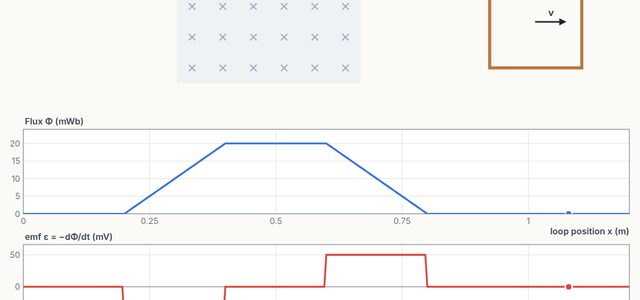
Open the Electromagnetic Induction simulation and test every idea on this page yourself.
Open the simulation →