The big idea
Light travels in straight lines called rays. At a mirror it reflects. Entering glass or water it slows down and bends, which is refraction. Lenses use refraction to form images.
Key ideas
- Angles are always measured from the normal, a line at 90° to the surface.
- Law of reflection: angle of incidence = angle of reflection.
- Going into a denser material, light slows and bends toward the normal. Coming out, it bends away.
- Beyond the critical angle, light inside the denser material is totally internally reflected. Optical fibres use this.
- A converging (convex) lens brings parallel rays to a focus. A diverging (concave) lens spreads them out.
Equations
| n = sin i / sin r | refractive index |
| sin c = 1 / n | critical angle |
Worked example
A ray enters a glass block at an angle of incidence of 40° and refracts at 25°. Find the refractive index and the critical angle.
- n = sin 40°/sin 25° = 0.643/0.423 = 1.52.
- sin c = 1/1.52 = 0.658, so c = 41°.
Common mistakes
- Measuring angles from the surface instead of the normal.
- Thinking total internal reflection can happen when light goes from air into glass. It only happens going from the denser material.
Try it yourself
A ray hits a plane mirror at 30° to the mirror surface. What is the angle of reflection?
Show the answer
The angle of incidence is 90° − 30° = 60°, so the angle of reflection is 60°.
Going deeper: GCSE exam level
Exam technique, a longer multi-step worked example and exam-style practice with hidden solutions.
Lenses and images
Draw two rays from the top of the object: one parallel to the axis that then passes through the focus, and one straight through the centre of the lens. Where they meet is the image. A real image can be shown on a screen; a virtual image cannot, because the rays only appear to come from it. Magnification = image height ÷ object height.
More worked examples
Example 1. An object 3.0 cm tall stands 30 cm from a converging lens of focal length 10 cm. Describe the image.
- Draw the ray diagram to scale (or use 1/v = 1/f − 1/u = 1/10 − 1/30).
- The rays meet 15 cm from the lens on the far side.
- The image is real, inverted and 1.5 cm tall.
- Magnification = 1.5/3.0 = 0.5.
Exam-style practice
1. A magnifying glass makes a 3 cm insect look 12 cm long. What is the magnification, and is the image real or virtual?
Show the solution
12/3 = 4; the image is virtual and upright.
2. How does an optical fibre keep light inside?
Show the solution
Light hits the wall at more than the critical angle and is totally internally reflected, again and again.
Where this fits in each exam board
| Cambridge IGCSE (0625) | Topic 3: Waves |
| Edexcel International GCSE (4PH1) | Section 3: Waves |
| AQA GCSE (8463) | 4.6 Waves (lenses: separate Physics only) |
4 questions to print or save, with full step-by-step answers at the end.
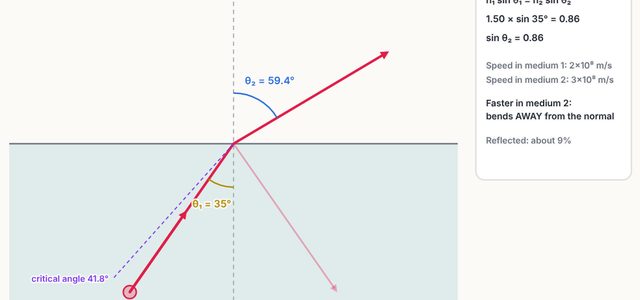
Open the Refraction & Total Internal Reflection simulation and test every idea on this page yourself.
Open the simulation →