The big idea
Magnets have a north and a south pole, and the space around them is a magnetic field. A current also produces a magnetic field. Put a current-carrying wire in a magnet's field and the two fields interact to push the wire: this is the motor effect.
Key ideas
- Field lines run from north to south. Closer lines mean a stronger field.
- A coil of wire (solenoid) carrying a current is an electromagnet. More turns, more current or an iron core make it stronger.
- The force on a wire is greatest when the wire is at right angles to the field.
- Fleming's left-hand rule: First finger = Field, seCond finger = Current, thuMb = Motion.
- A motor is a coil in a magnetic field. The forces on its two sides are opposite, so it spins.
Equations
| F = BIL | force on a wire at right angles to the field |
Worked example
A 0.50 m wire carrying 3.0 A lies at right angles to a magnetic field of 0.20 T. Find the force on it.
- F = BIL = 0.20 × 3.0 × 0.50.
- F = 0.30 N, at right angles to both the wire and the field.
Common mistakes
- Using the right hand for the motor effect. The left hand is for motors; the right is for generators.
- Expecting a force when the wire is parallel to the field. There is none.
Try it yourself
State three ways to make an electromagnet stronger.
Show the answer
More turns on the coil, a larger current, and adding a soft iron core.
Going deeper: GCSE exam level
Exam technique, a longer multi-step worked example and exam-style practice with hidden solutions.
How a d.c. motor works
The current flows in opposite directions along the two sides of the coil, so one side is pushed up and the other down, and the coil turns. Every half turn, the split-ring commutator swaps the connections, reversing the current so the coil keeps turning the same way. More current, more turns or a stronger magnet all give a bigger turning effect. A loudspeaker uses the same force to move a cone back and forth.
More worked examples
Example 1. A motor coil has 50 turns. Each side is 0.040 m long and lies in a field of 0.30 T. The current is 2.0 A. Find the force on one side of the coil.
- Force on one wire: F = BIL = 0.30 × 2.0 × 0.040 = 0.024 N.
- With 50 turns: 50 × 0.024 = 1.2 N.
- The other side feels 1.2 N in the opposite direction, so together they turn the coil.
Exam-style practice
1. What happens to the force on a wire if both the current and the magnetic field are reversed?
Show the solution
It stays in the same direction.
2. How could you show the shape of the magnetic field around a bar magnet?
Show the solution
Use iron filings, or move a plotting compass around it and mark where it points.
Where this fits in each exam board
| Cambridge IGCSE (0625) | Topic 4: Electricity and magnetism |
| Edexcel International GCSE (4PH1) | Section 6: Magnetism and electromagnetism |
| AQA GCSE (8463) | 4.7 Magnetism and electromagnetism |
4 questions to print or save, with full step-by-step answers at the end.
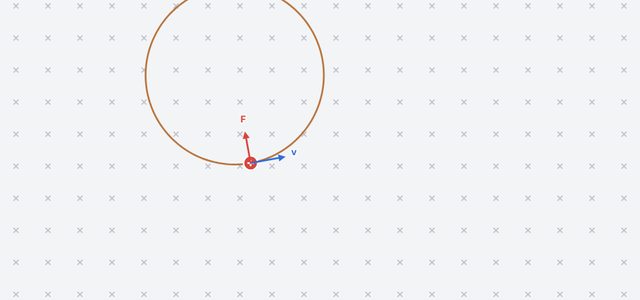
Open the Magnetic Force simulation and test every idea on this page yourself.
Open the simulation →