The big idea
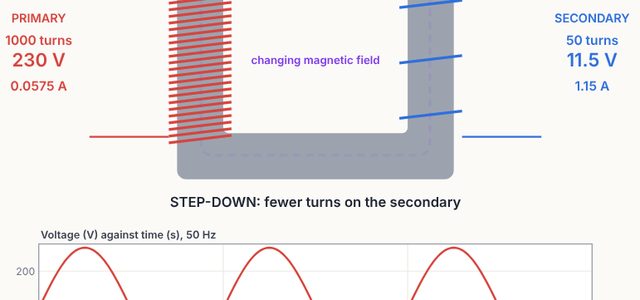
Move a magnet near a coil, or change the magnetic field through it, and a voltage is induced. This is how generators make electricity. A transformer uses a changing magnetic field in an iron core to step an alternating voltage up or down.
Key ideas
- A voltage is induced only while the magnetic field through the coil is changing.
- A bigger voltage comes from moving faster, a stronger magnet or more turns.
- A transformer only works with alternating current.
- More turns on the secondary coil than the primary steps the voltage up; fewer steps it down.
- For an ideal transformer, power in = power out, so stepping the voltage up steps the current down.
Equations
| Vp / Vs = Np / Ns | turns ratio |
| VpIp = VsIs | 100% efficient transformer |
Worked example
A transformer has 1000 turns on its primary coil and 50 on its secondary. The primary is connected to 230 V. Find the secondary voltage, and the primary current when the secondary supplies 4.0 A.
- Vs = Vp × Ns/Np = 230 × 50/1000 = 11.5 V (a step-down transformer).
- Power out = 11.5 × 4.0 = 46 W = power in.
- Ip = 46/230 = 0.20 A.
Common mistakes
- Connecting a transformer to a battery and expecting an output. Direct current gives a steady field, so nothing is induced.
- Thinking a step-up transformer gives you extra energy. The current falls as the voltage rises.
Try it yourself
Why is electricity sent along power lines at 400 000 V?
Show the answer
High voltage means low current for the same power, so much less energy is wasted heating the cables (P = I²R).
Going deeper: GCSE exam level
Exam technique, a longer multi-step worked example and exam-style practice with hidden solutions.
Generators
In an a.c. generator (alternator) a coil spins in a magnetic field and slip rings carry the alternating current out. Spinning faster gives a bigger voltage and a higher frequency. A dynamo uses a commutator instead, so its output is always in one direction. The induced current always acts to oppose the change that causes it.
More worked examples
Example 1. A power-station transformer steps 25 kV up to 400 kV. Its primary coil has 2000 turns. Find the number of secondary turns and say what happens to the current.
- Ns/Np = Vs/Vp = 400/25 = 16.
- Ns = 16 × 2000 = 32 000 turns.
- Power in = power out, so the current falls by a factor of 16.
Exam-style practice
1. A magnet is pushed into a coil and a meter flicks to the right. What happens when the magnet is (a) held still inside, (b) pulled out quickly?
Show the solution
(a) No reading. (b) A larger flick to the left.
2. A transformer changes 230 V to 12 V and supplies 24 W. Find the primary current.
Show the solution
I = P/V = 24/230 = 0.10 A.
Where this fits in each exam board
| Cambridge IGCSE (0625) | Topic 4: Electricity and magnetism |
| Edexcel International GCSE (4PH1) | Section 6: Magnetism and electromagnetism |
| AQA GCSE (8463) | 4.7 Magnetism and electromagnetism (separate Physics only) |
4 questions to print or save, with full step-by-step answers at the end.
Open the Transformers & Power Transmission simulation and test every idea on this page yourself.
Open the simulation →