The big idea
An atom has a tiny positive nucleus of protons and neutrons, surrounded by electrons. Some nuclei are unstable and give out radiation to become more stable. The three main types are alpha, beta and gamma.
Key ideas
- Atomic (proton) number Z = number of protons. Mass (nucleon) number A = protons + neutrons. Isotopes have the same Z but different A.
- Alpha (2 protons + 2 neutrons): strongly ionising, stopped by paper or a few cm of air.
- Beta (a fast electron from the nucleus): stopped by a few mm of aluminium.
- Gamma (an electromagnetic wave): weakly ionising, reduced by thick lead or concrete.
- Decay is random: you cannot predict when one particular nucleus will decay.
Equations
| alpha: A − 4, Z − 2 | |
| beta: A unchanged, Z + 1 | |
| gamma: A and Z unchanged |
Worked example
Radium-226 (Z = 88) decays by alpha emission. What are the mass and atomic numbers of the new nucleus?
- An alpha particle carries away 4 nucleons, including 2 protons.
- A = 226 − 4 = 222. Z = 88 − 2 = 86.
- Element 86 is radon: the product is radon-222.
Common mistakes
- Saying beta particles come from the electron shells. They come from the nucleus, when a neutron turns into a proton.
- Confusing irradiation (being exposed) with contamination (having the source on or in you).
Try it yourself
Carbon-14 (Z = 6) decays by beta emission. What does it become?
Show the answer
A stays 14 and Z rises to 7: nitrogen-14.
Going deeper: GCSE exam level
Exam technique, a longer multi-step worked example and exam-style practice with hidden solutions.
How the model of the atom changed
Thomson's plum pudding model was a ball of positive charge with electrons dotted through it. The alpha-scattering experiment disproved it: most alpha particles went straight through gold foil, but a few bounced back, so the positive charge and mass must be in a tiny nucleus. Bohr then put the electrons in fixed energy levels, and later the neutron was discovered.
Choosing a source
Match the radiation to the job. Smoke detector: alpha, which is easily absorbed by smoke. Thickness gauge for paper or foil: beta. Medical tracer or sterilising equipment: gamma, which passes out of the body or through packaging.
More worked examples
Example 1. Uranium-238 (Z = 92) emits an alpha particle, and the product then emits a beta particle. Write both decays.
- Alpha: A falls by 4 and Z by 2: ²³⁸₉₂U → ²³⁴₉₀Th + ⁴₂He.
- Beta: A is unchanged and Z rises by 1: ²³⁴₉₀Th → ²³⁴₉₁Pa + ⁰₋₁e.
- Check that the top and bottom numbers balance on each side.
Exam-style practice
1. How many neutrons are in a nucleus of carbon-14 (Z = 6)?
Show the solution
14 − 6 = 8.
2. Why is an alpha source more dangerous inside the body than outside it?
Show the solution
Outside, the skin stops it. Inside, it is strongly ionising and all its energy is absorbed by nearby cells.
Where this fits in each exam board
| Cambridge IGCSE (0625) | Topic 5: Nuclear physics |
| Edexcel International GCSE (4PH1) | Section 7: Radioactivity and particles |
| AQA GCSE (8463) | 4.4 Atomic structure |
4 questions to print or save, with full step-by-step answers at the end.
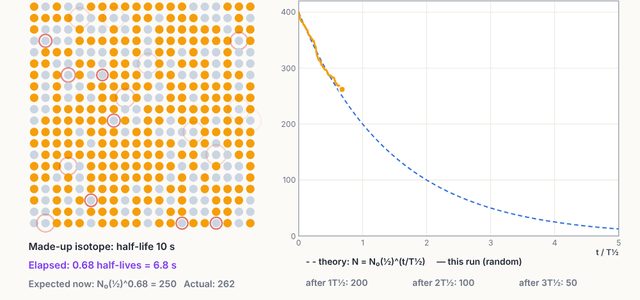
Open the Nuclear Decay & Binding Energy simulation and test every idea on this page yourself.
Open the simulation →