The big idea
The half-life of a radioactive isotope is the time for half of its nuclei to decay, which is also the time for its activity to halve. Splitting large nuclei (fission) or joining small ones (fusion) releases huge amounts of energy.
Key ideas
- Activity is the number of decays per second, measured in becquerels (Bq).
- After 1 half-life ½ remains, after 2 half-lives ¼, after 3 half-lives ⅛.
- Always subtract the background count before using count-rate data.
- Fission: a neutron splits a uranium nucleus, releasing energy and more neutrons, which can cause a chain reaction.
- Fusion: light nuclei join at very high temperature and pressure. It powers the Sun.
Equations
| fraction left = (½)n | after n half-lives |
Worked example
The corrected count rate from a source falls from 800 counts/min to 100 counts/min in 6.0 hours. Find the half-life.
- 800 → 400 → 200 → 100 is 3 halvings.
- Three half-lives take 6.0 hours.
- Half-life = 6.0/3 = 2.0 hours.
Common mistakes
- Thinking the source is completely gone after two half-lives. A quarter is still there.
- Forgetting to subtract background radiation.
Try it yourself
A sample has a half-life of 5 days. What fraction remains after 20 days?
Show the answer
20/5 = 4 half-lives, so (½)⁴ = 1/16.
Going deeper: GCSE exam level
Exam technique, a longer multi-step worked example and exam-style practice with hidden solutions.
Working with real data
Subtract the background count from every reading first. On a graph of corrected count rate against time, read off the time for the count to halve, and repeat for a second halving to check. Sources for medical tracers need a short half-life (hours) so they do not stay active in the body; sources for smoke detectors need a long one.
More worked examples
Example 1. A detector reads 130 counts per minute near a source. Twelve hours later it reads 25. The background count is 10 per minute. Find the half-life.
- Corrected readings: 130 − 10 = 120 and 25 − 10 = 15.
- 120 → 60 → 30 → 15 is three halvings.
- Half-life = 12/3 = 4 hours.
Exam-style practice
1. A sample of old wood has 25% of the carbon-14 of living wood. The half-life is 5700 years. How old is it?
Show the solution
25% is two half-lives: 11 400 years.
2. What do the control rods do in a nuclear reactor?
Show the solution
They absorb neutrons, so that on average only one neutron from each fission goes on to cause another.
Where this fits in each exam board
| Cambridge IGCSE (0625) | Topic 5: Nuclear physics |
| Edexcel International GCSE (4PH1) | Section 7: Radioactivity and particles |
| AQA GCSE (8463) | 4.4 Atomic structure |
4 questions to print or save, with full step-by-step answers at the end.
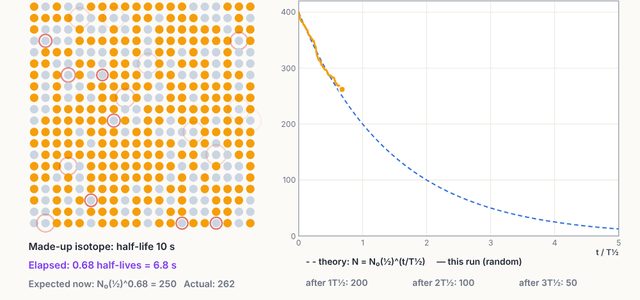
Open the Nuclear Decay & Binding Energy simulation and test every idea on this page yourself.
Open the simulation →