The big idea
Gravity holds planets in orbit around the Sun and moons around planets. Stars form from clouds of gas, shine for millions or billions of years by nuclear fusion, and end in different ways depending on their mass. Light from distant galaxies shows that the Universe is expanding.
Key ideas
- An orbiting object keeps changing direction, so its velocity changes even at constant speed. Gravity provides the force toward the centre.
- The closer the orbit, the faster the object must move.
- A star like the Sun: nebula → protostar → main sequence → red giant → white dwarf. A much bigger star: red supergiant → supernova → neutron star or black hole.
- Red-shift: light from distant galaxies is stretched to longer wavelengths because they are moving away. The farther the galaxy, the bigger the red-shift.
- Red-shift and the cosmic microwave background are evidence for the Big Bang.
Equations
| v = 2πr / T | orbital speed |
Worked example
The International Space Station orbits 6.77 × 10⁶ m from Earth's centre once every 5540 s. Find its speed.
- v = 2πr/T = 2π × 6.77 × 10⁶/5540.
- v = 7700 m/s (7.7 km/s).
Common mistakes
- Using the height above the surface instead of the distance from Earth's centre for r.
- Saying the Sun will become a supernova. It is not massive enough.
Try it yourself
What does the red-shift of distant galaxies tell us?
Show the answer
They are moving away from us, and more distant ones move faster, so the Universe is expanding.
Going deeper: GCSE exam level
Exam technique, a longer multi-step worked example and exam-style practice with hidden solutions.
Evidence and reasoning
Stars are stable on the main sequence because the outward pressure from fusion balances the inward pull of gravity. Elements up to iron are made by fusion in stars; heavier ones are made in supernovae. The cosmic microwave background radiation is the cooled-down glow of the early Universe, and only the Big Bang theory explains it.
More worked examples
Example 1. The Earth orbits the Sun at a radius of 1.5 × 10¹¹ m once every 3.16 × 10⁷ s. Find its orbital speed.
- v = 2πr/T = 2π × 1.5 × 10¹¹/3.16 × 10⁷.
- v = 3.0 × 10⁴ m/s (30 km/s).
Exam-style practice
1. Where in its orbit does a comet move fastest, and why?
Show the solution
Closest to the Sun: gravity is strongest there, and potential energy has been transferred to kinetic energy.
2. What will the Sun become at the end of its life?
Show the solution
A red giant, then a white dwarf (and eventually a black dwarf).
Where this fits in each exam board
| Cambridge IGCSE (0625) | Topic 6: Space physics |
| Edexcel International GCSE (4PH1) | Section 8: Astrophysics |
| AQA GCSE (8463) | 4.8 Space physics (separate Physics only) |
4 questions to print or save, with full step-by-step answers at the end.
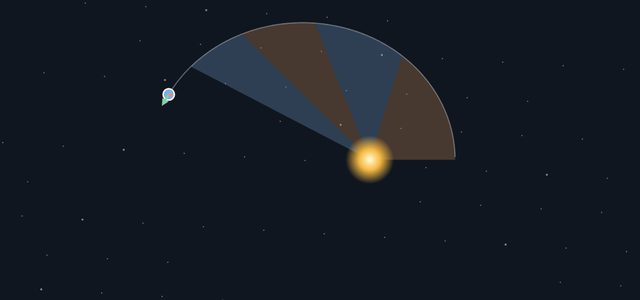
Open the Orbits & Kepler's Laws simulation and test every idea on this page yourself.
Open the simulation →