The big idea
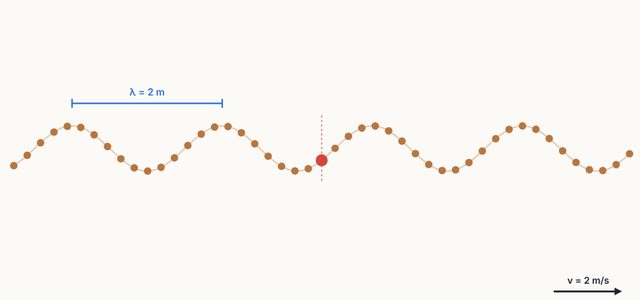
Sound is a longitudinal wave: the particles of the medium vibrate back and forth along the direction of travel, making compressions and rarefactions. It needs a medium, so it cannot travel through a vacuum. It travels fastest in solids and slowest in gases.
Key ideas
- Pitch depends on frequency: higher frequency, higher pitch. Loudness depends on amplitude.
- Human hearing ranges from about 20 Hz to 20 000 Hz. Sound above 20 kHz is ultrasound.
- An echo is a reflected sound. The sound travels there and back, so the distance is half of speed × time.
- Ultrasound partly reflects at every boundary between materials, which is used for scanning unborn babies, finding cracks in metal and measuring depth (sonar).
- On an oscilloscope trace, more waves on the screen means a higher pitch, and taller waves means a louder sound.
Equations
| v = fλ | |
| distance = v × t / 2 | for an echo |
Worked example
An ultrasound pulse is sent into the body at 1500 m/s. An echo from an organ returns 40 µs later. How deep is the organ?
- Distance there and back = vt = 1500 × 40 × 10⁻⁶ = 0.060 m.
- Depth = 0.060/2 = 0.030 m (3.0 cm).
Common mistakes
- Forgetting to halve the distance for an echo.
- Saying sound travels fastest in air or in a vacuum.
Try it yourself
Sound travels at 340 m/s in air. What is the wavelength of the highest note a person can hear (20 kHz)?
Show the answer
λ = v/f = 340/20 000 = 0.017 m (1.7 cm).
Going deeper: GCSE exam level
Exam technique, a longer multi-step worked example and exam-style practice with hidden solutions.
Seeing sound
A microphone and oscilloscope show a sound as a trace. The period is the time for one complete wave on the screen, and frequency = 1/period. In the ear, sound waves make the eardrum vibrate, which is why we only hear a limited range of frequencies.
More worked examples
Example 1. On an oscilloscope, one complete wave of a sound takes 2.5 ms. Find the frequency. Is it audible? Find its wavelength in air (340 m/s).
- f = 1/T = 1/0.0025 = 400 Hz.
- It is between 20 Hz and 20 000 Hz, so it is audible.
- λ = v/f = 340/400 = 0.85 m.
Exam-style practice
1. Why can't astronauts on a spacewalk talk to each other without radios?
Show the solution
Sound needs a medium, and space is a vacuum. Radio waves do not need one.
2. A sound gets louder and higher. How does its oscilloscope trace change?
Show the solution
The waves get taller (bigger amplitude) and closer together (higher frequency).
Where this fits in each exam board
| Cambridge IGCSE (0625) | Topic 3: Waves |
| Edexcel International GCSE (4PH1) | Section 3: Waves |
| AQA GCSE (8463) | 4.6 Waves (separate Physics only) |
4 questions to print or save, with full step-by-step answers at the end.
Open the Waves & Sound simulation and test every idea on this page yourself.
Open the simulation →