The big idea
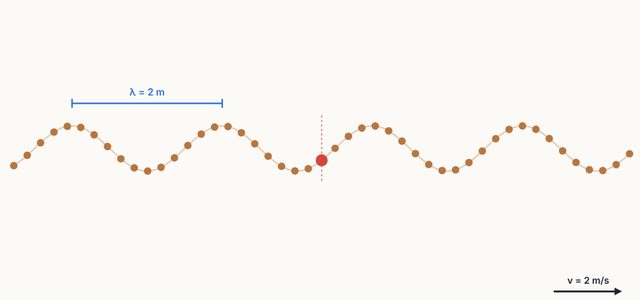
A wave transfers energy from place to place without transferring matter. In a transverse wave the vibrations are at right angles to the direction of travel (light, water ripples). In a longitudinal wave they are along it (sound).
Key ideas
- Amplitude: maximum displacement from the rest position. Wavelength: distance from one crest to the next.
- Frequency: waves per second (Hz). Period: time for one wave, T = 1/f.
- Wave speed = frequency × wavelength.
- Waves can be reflected, refracted (change speed and direction) and absorbed.
- Sound needs a medium and travels fastest in solids. Humans hear about 20 Hz to 20 kHz; above that is ultrasound.
Equations
| v = fλ | wave equation |
| T = 1 / f | period |
Worked example
Water waves have a frequency of 4.0 Hz and a wavelength of 0.50 m. Find their speed and period.
- v = fλ = 4.0 × 0.50 = 2.0 m/s.
- T = 1/f = 1/4.0 = 0.25 s.
Common mistakes
- Measuring amplitude from crest to trough. It is from the middle to a crest.
- Thinking the water itself travels along with the wave.
Try it yourself
A sound wave travels at 340 m/s with frequency 170 Hz. Find its wavelength.
Show the answer
λ = v/f = 340/170 = 2.0 m.
Going deeper: GCSE exam level
Exam technique, a longer multi-step worked example and exam-style practice with hidden solutions.
Measuring wave speed
Sound in air: stand a measured distance from a wall, clap and time the echo; the sound travels there and back. Water waves: in a ripple tank, count the waves passing a point in a set time to get the frequency, and measure the length of several waves to get the wavelength. When a wave enters a medium where it travels more slowly, its wavelength gets shorter but its frequency stays the same.
More worked examples
Example 1. A student claps 85 m from a wall and hears the echo 0.50 s later. Find the speed of sound. In a ripple tank, 12 waves pass a point in 3.0 s and 10 wavelengths measure 15 cm: find the wave speed.
- Sound: distance = 2 × 85 = 170 m, so v = 170/0.50 = 340 m/s.
- Ripples: f = 12/3.0 = 4.0 Hz; λ = 15/10 = 1.5 cm.
- v = fλ = 4.0 × 1.5 = 6.0 cm/s.
Exam-style practice
1. A sonar pulse returns to a ship 0.40 s after it is sent. Sound travels at 1500 m/s in water. How deep is the sea?
Show the solution
Distance there and back = 600 m, so the depth is 300 m.
2. Water waves pass from deep to shallow water. What happens to their speed, wavelength and frequency?
Show the solution
Speed and wavelength decrease; frequency is unchanged.
Where this fits in each exam board
| Cambridge IGCSE (0625) | Topic 3: Waves |
| Edexcel International GCSE (4PH1) | Section 3: Waves |
| AQA GCSE (8463) | 4.6 Waves |
4 questions to print or save, with full step-by-step answers at the end.
Open the Waves & Sound simulation and test every idea on this page yourself.
Open the simulation →