The big idea
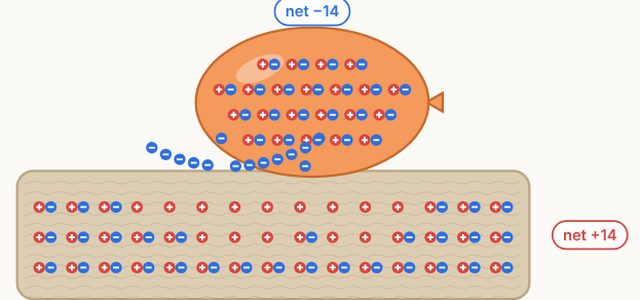
Rubbing two insulators together moves electrons from one to the other. The one that gains electrons becomes negative, and the one that loses them becomes positive by the same amount. Like charges repel and unlike charges attract.
Key ideas
- Only electrons move. Positive charges (protons) stay fixed in the nuclei.
- A charged object creates an electric field around it. The field is strongest close to the object.
- A charged object can attract a neutral one by pulling or pushing its electrons to one side (induction).
- If enough charge builds up, the air breaks down and a spark jumps. Earthing lets charge flow away safely.
Equations
| Q = It | charge (C) |
Worked example
A polythene rod is rubbed with a cloth and becomes negatively charged. Explain what happened, and the charge on the cloth.
- Friction transfers electrons from the cloth to the rod.
- The rod has extra electrons, so it is negative.
- The cloth has lost the same number of electrons, so it has an equal positive charge.
Common mistakes
- Saying positive charges moved onto the object.
- Saying a charged balloon sticks to a wall because the wall is oppositely charged. The wall is neutral: its charges are just rearranged.
Try it yourself
Why are aircraft earthed with a cable during refuelling?
Show the answer
Fuel flowing through the pipe builds up static charge. Earthing lets it flow away so no spark can ignite the fuel vapour.
Going deeper: GCSE exam level
Exam technique, a longer multi-step worked example and exam-style practice with hidden solutions.
Using and avoiding static
Uses: in electrostatic paint spraying the droplets are all given the same charge, so they repel each other into a fine, even mist and are attracted to the earthed object. Photocopiers and smoke precipitators in chimneys work the same way. Dangers: a spark can ignite fuel vapour or dust, so tankers and aircraft are earthed before refuelling.
More worked examples
Example 1. A spark carries 2.0 µC of charge in 1.0 ms. Find the average current and the number of electrons transferred (e = 1.6 × 10⁻¹⁹ C).
- I = Q/t = 2.0 × 10⁻⁶/1.0 × 10⁻³ = 2.0 mA.
- Number of electrons = 2.0 × 10⁻⁶/1.6 × 10⁻¹⁹ = 1.25 × 10¹³.
Exam-style practice
1. Two balloons are rubbed with the same cloth and hung side by side. What happens, and why?
Show the solution
They repel: both gained the same type of charge.
2. Why does spray paint reach the back of an earthed car part?
Show the solution
The charged droplets follow the electric field lines, which curve round to the earthed object.
Where this fits in each exam board
| Cambridge IGCSE (0625) | Topic 4: Electricity and magnetism |
| Edexcel International GCSE (4PH1) | Section 2: Electricity |
| AQA GCSE (8463) | 4.2 Electricity (separate Physics only) |
4 questions to print or save, with full step-by-step answers at the end.
Open the Charging Methods simulation and test every idea on this page yourself.
Open the simulation →