The big idea
An angle measures a turn, in degrees. A quarter turn is 90°, called a right angle. Lines that never meet are parallel; lines that cross at a right angle are perpendicular. A shape has symmetry if it can be folded so that the two halves match.
Key ideas
- Acute angles are less than 90°. A right angle is exactly 90°. Obtuse angles are between 90° and 180°.
- A straight line is 180° and a full turn is 360°.
- Angles that join to make a larger angle add up.
- A line of symmetry is a fold line where one half is a mirror image of the other.
Equations
| right angle = 90° | quarter turn |
| straight line = 180° | half turn |
| full turn = 360° | whole turn |
| acute < 90° < obtuse < 180° | types of angle |
Worked questions: easy, medium, hard
Three questions that climb in difficulty, each solved one step at a time. Try each one before you read the steps.
Is an angle of 35° acute, right or obtuse? What about 120°?
- 35° is less than 90°, so it is acute.
- 120° is more than 90° but less than 180°.
- So it is obtuse.
Two angles sit side by side on a straight line. One is 65°. Find the other.
- Angles on a straight line add up to 180°.
- 180 − 65.
- = 115°.
How many lines of symmetry does a square have? How many does a rectangle (that is not a square) have?
- A square can be folded across the middle two ways and along both diagonals.
- That makes 4 lines of symmetry.
- A rectangle can only be folded across the middle two ways; its diagonals do not work.
- So it has 2.
Common mistakes
- Reading the wrong scale on a protractor.
- Thinking a longer arm makes a bigger angle.
- Counting the diagonal of a rectangle as a line of symmetry.
Now you try: easy to hard
Six more questions, two at each level. These are the questions on the worksheet; each solution opens when you are ready.
Easy 1. What kind of angle is 90°?
Show the step-by-step solution
A right angle.
Easy 2. How many degrees are in a half turn?
Show the step-by-step solution
180°.
Medium 3. A right angle is split into two angles. One is 40°. What is the other?
Show the step-by-step solution
90 − 40 = 50°.
Medium 4. Are the opposite sides of a rectangle parallel or perpendicular?
Show the step-by-step solution
Parallel. (Sides that meet at a corner are perpendicular.)
Hard 5. How many lines of symmetry does an equilateral triangle have?
Show the step-by-step solution
3.
Hard 6. The minute hand of a clock moves from 12 to 4. Through how many degrees does it turn?
Show the step-by-step solution
Each number is 360 ÷ 12 = 30°. 4 × 30 = 120°.
6 questions to print or save, with full step-by-step answers at the end.
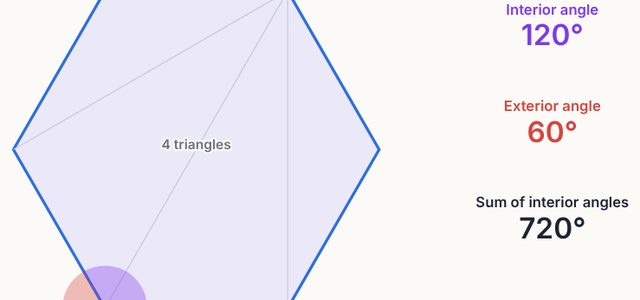
Open the Geometry Lab simulation and test every idea on this page yourself.
Open the simulation →