K–8 Mathematics
From counting in kindergarten to pre-algebra in Grade 8, organised grade by grade: number, fractions, decimals, ratio, geometry, statistics and first equations. 44 lessons in course-unit order, each linked to its simulation, with an exam-level section marked Easy · Medium · Hard.
Kindergarten
Counting to 20 and Comparing
Count objects up to 20, write the numbers, and say which group has more or fewer.
Adding and Taking Away within 10
Put groups together, take some away, and learn the pairs of numbers that make 10.
Shapes, Sorting and Patterns
Name flat and solid shapes, describe where things are, sort objects, and continue a pattern.
Grade 1
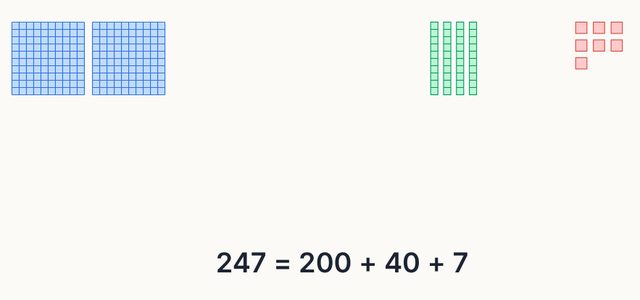
Numbers to 100: Tens and Ones
Read and write numbers to 100, split them into tens and ones, compare them, and find 10 more or 10 less.
Addition and Subtraction Facts to 20
Use doubles, making ten and fact families to add and subtract quickly within 20.
Telling Time and Measuring Length
Read a clock to the hour and half hour, and measure and compare lengths.
Grade 2
Counting and Place Value
Count, read and write numbers, and understand hundreds, tens and ones.
Addition and Subtraction
Add and subtract within 20 using number facts, then larger numbers by regrouping tens and ones.
Equal Groups, Arrays, and Odd and Even
Add equal groups, see them as rows and columns, skip count, and tell odd numbers from even numbers.
Shapes, Measurement and Time
Name flat and solid shapes, measure length, and tell the time.
Money and Picture Graphs
Count coins, make amounts and work out change, and read tally charts, picture graphs and bar graphs.
Grade 3
Rounding and Adding and Subtracting within 1000
Round to the nearest 10 and 100, estimate answers, and add and subtract three-digit numbers.
Multiplication and Division Facts
Understand × and ÷ as equal groups, learn the times tables, and use one fact to find another.
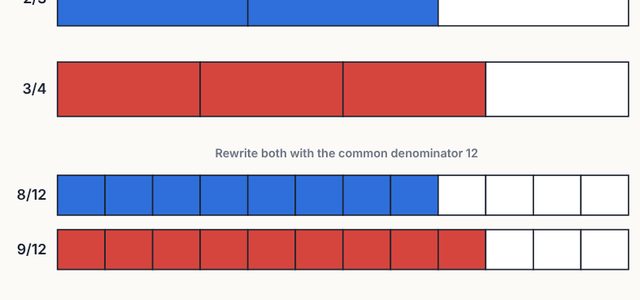
Fractions of a Whole and on a Number Line
Understand unit fractions, place fractions on a number line, compare them and find simple equivalents.
Time, Mass and Liquid Volume
Tell the time to the minute, find how long something lasts, and measure in grams, kilograms, millilitres and litres.
Perimeter, Area and Volume
Measure round the edge of a shape, the space inside it, and the space inside a box.
Grade 4
Place Value to Millions
Read, write, compare and round large whole numbers, and add and subtract them.
Multiplication and Division
Times tables, multiplying larger numbers by splitting them, and dividing with remainders.
Multi-Digit Multiplication and Long Division
Multiply by two-digit numbers and divide by a one-digit number, with remainders.
Factors, Multiples and Prime Numbers
Find factors and multiples, recognise prime numbers, and use prime factors to find the HCF and LCM.
Understanding Fractions
Fractions as equal parts, equivalent fractions, comparing, mixed numbers, and adding and subtracting.
Angles, Lines and Symmetry
Name and measure angles, recognise parallel and perpendicular lines, and find lines of symmetry.
Measurement and Unit Conversions
Convert between metric units of length, mass and capacity, and between units of time, and solve problems with them.
Grade 5
Decimals
Tenths, hundredths and thousandths, ordering and rounding decimals, and the four operations with decimals.
Multiplying and Dividing Fractions
Multiply a fraction by a whole number and by a fraction, and divide with unit fractions.
Order of Operations and Powers of 10
Evaluate expressions with brackets in the correct order, and multiply and divide by powers of 10.
The Coordinate Plane and Number Patterns
Plot and read points with ordered pairs, and find and graph the rule that links two patterns.
Classifying Triangles and Quadrilaterals
Sort triangles by sides and angles, and understand how the quadrilaterals are related.
Line Plots, Averages and Volume
Read line plots, find the mean, median, mode and range of a small data set, and find volumes of boxes.
Grades 6–8 · Number
Integers, Order of Operations and the Coordinate Plane
Calculate with negative numbers, apply the order of operations, and plot points in all four quadrants.
Fractions, Decimals and Percentages
Calculate with fractions, switch between fractions, decimals and percentages, and use multipliers for percentage change.
Ratio, Proportion and Rates of Change
Share in a ratio, use direct and inverse proportion, work with compound measures, and model repeated percentage change.
Indices, Standard Form and Surds
The laws of indices including negative and fractional powers, numbers in standard form, and exact answers with surds.
Grades 6–8 · Algebra
Expressions, Brackets and Rearranging Formulae
Collect like terms, expand and factorise, simplify algebraic fractions and change the subject of a formula.
Linear Equations and Inequalities
Solve equations with brackets, fractions and the unknown on both sides, and solve and represent inequalities.
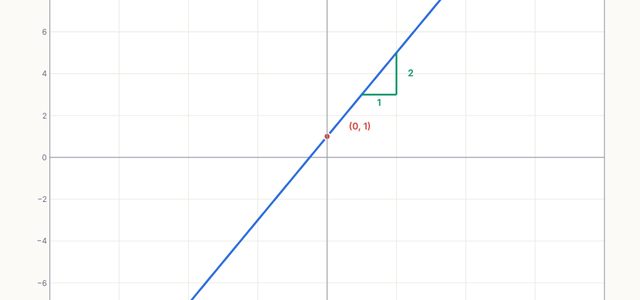
Straight-Line Graphs
Gradient and intercept, the equation y = mx + c, parallel and perpendicular lines, midpoints and distances.
Simultaneous Equations
Find the values that satisfy two equations at once, by elimination, by substitution, and where a line meets a curve.
Sequences
Find and use nth-term rules for arithmetic, geometric and quadratic sequences.
Grades 6–8 · Geometry
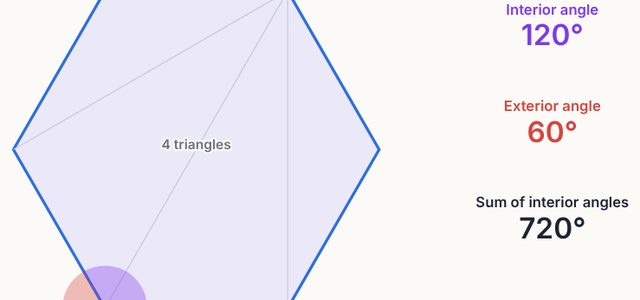
Angles, Parallel Lines and Polygons
Angle facts for lines, triangles and parallel lines, and the interior and exterior angles of polygons.
Area, Volume and Similar Shapes
Areas of plane shapes and sectors, surface areas and volumes of solids, and how scale factors affect area and volume.
Pythagoras' Theorem and Right-Angled Trigonometry
Find missing sides and angles in right-angled triangles, including problems in three dimensions.
Transformations and Vectors
Translations, reflections, rotations and enlargements, column vectors, and vector methods for geometric proof.
Grades 6–8 · Statistics and probability
Statistics: Averages, Spread and Diagrams
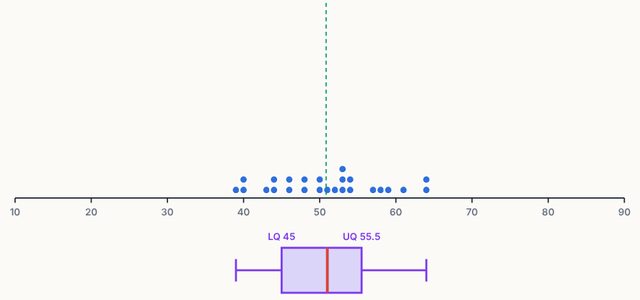
Mean, median, mode and range, estimates from grouped data, quartiles and box plots, and histograms.
Probability
Single and combined events, tree diagrams with and without replacement, Venn diagrams and conditional probability.