AP Calculus BC
Everything in AB plus the BC-only topics: integration by parts, partial fractions, improper integrals, Euler and logistic models, arc length, parametric and polar curves, and series. 26 lessons in course-unit order, each linked to its simulation, with an exam-level section marked Easy · Medium · Hard.
Unit 1 · Limits and Continuity
Limits and Limit Laws
What a function approaches, and the algebra tricks (factor, conjugate, divide by the highest power) that find it.
Continuity, Asymptotes and the Intermediate Value Theorem
The three-part test for continuity, the types of discontinuity, asymptotes as limits, and the IVT.
Unit 2 · Differentiation: Definition and Basic Rules
The Derivative as a Limit
Average rate of change becomes instantaneous rate of change: the slope of a secant line becomes the slope of the tangent.
Power, Product, Quotient and Chain Rules
The four rules that differentiate almost any algebraic function without going back to the limit.
Derivatives of Trig, Exponential and Log Functions
The derivative table for sin, cos, tan, ex, ax, ln x and the inverse trig functions, combined with the chain rule.
Unit 3 · Composite, Implicit and Inverse Functions
Implicit Differentiation and Inverse Functions
Differentiate equations that are not solved for y, find second derivatives, and get the derivative of an inverse function.
Unit 4 · Contextual Applications of Differentiation
Motion Along a Line
Position, velocity and acceleration as successive derivatives: at rest, changing direction, speeding up and slowing down.
Related Rates
When two changing quantities are linked by an equation, their rates of change are linked too.
L'Hôpital's Rule
A derivative-based shortcut for limits of the form 0/0 or ∞/∞, and how to convert other indeterminate forms.
Unit 5 · Analytical Applications of Differentiation
Tangent Lines, Linear Approximation and the Mean Value Theorem
Use the tangent line to approximate a function, and the MVT to link average and instantaneous rates.
Extrema, Concavity and Curve Sketching
What f′ and f″ say about a graph: where it rises and falls, where it bends, and where its maxima and minima are.
Optimisation
Turn a word problem into a function of one variable, then use the derivative to find the largest or smallest value.
Unit 6 · Integration and Accumulation of Change
Antiderivatives and u-Substitution
Reverse the derivative rules, remember the + C, and undo the chain rule with a substitution.
Riemann Sums, Definite Integrals and the Fundamental Theorem
Area as a limit of rectangles, the definite integral, and the theorem that connects it to antiderivatives.
Integration by Parts and Partial Fractions
Two BC techniques: undo the product rule with integration by parts, and split rational functions into simple fractions.
Improper Integrals
Integrals over infinite intervals or across a vertical asymptote: replace the trouble spot with a limit.
Unit 7 · Differential Equations
Differential Equations and Slope Fields
Read a slope field, separate variables, and solve growth, decay and cooling problems.
Euler's Method and Logistic Growth
Step along a slope field to approximate a solution, and model growth that levels off at a carrying capacity.
Unit 8 · Applications of Integration
Accumulation, Net Change and Motion with Integrals
The integral of a rate is the net change: displacement and distance from velocity, and amounts from flow rates.
Area Between Curves
Integrate (top − bottom) with respect to x, or (right − left) with respect to y, between the points where the curves meet.
Volumes of Solids
Disks, washers and known cross-sections: slice the solid, write the area of a slice, and integrate.
Unit 9 · Parametric Equations, Polar Coordinates and Vector-Valued Functions
Parametric Equations and Vector-Valued Functions
Curves traced by x(t) and y(t): slopes, second derivatives, speed and distance travelled.
Polar Curves
Points described by distance and angle: converting, slopes of polar curves, and areas swept out from the origin.
Unit 10 · Infinite Sequences and Series
Infinite Series and Convergence Tests
When does an infinite sum have a finite total? Geometric series, p-series and the main convergence tests.
Taylor and Maclaurin Series
Build polynomials that match a function's derivatives, find where power series converge, and bound the error.
Simulations for AP Calculus BC
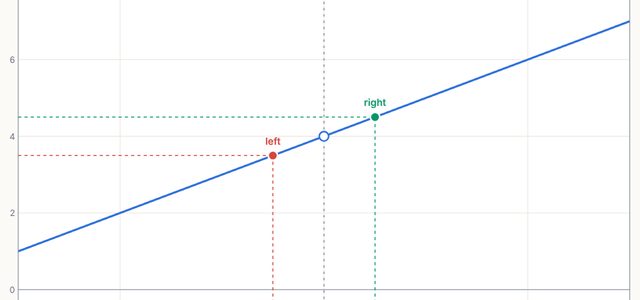 LimitsLimits Explorer
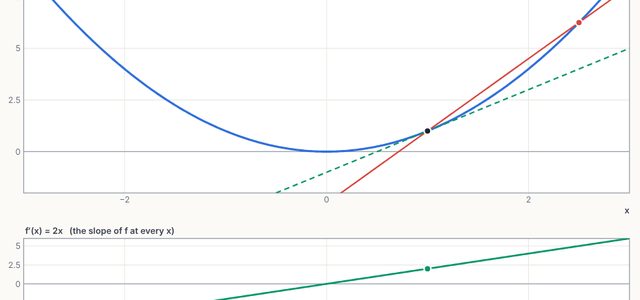 DerivativesDerivative Explorer
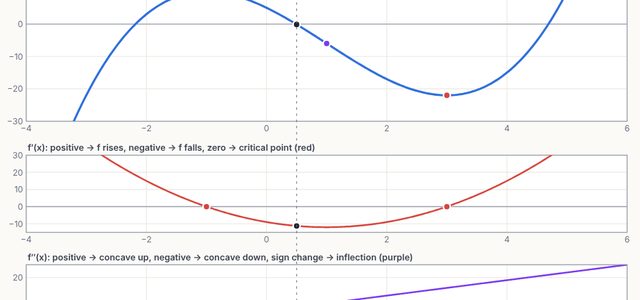 Applications of derivativesCurve Sketching & Optimisation
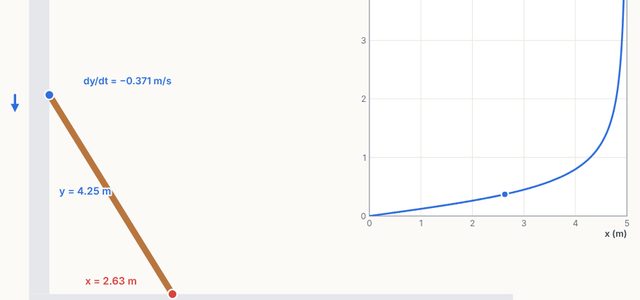 Applications of derivativesRelated Rates
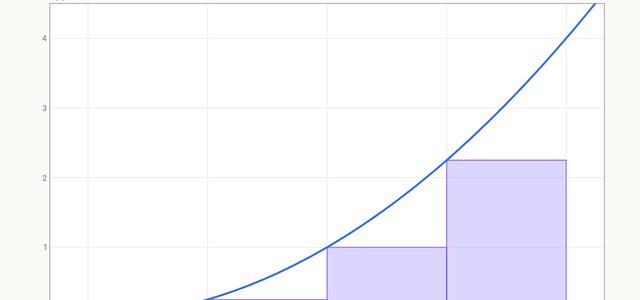 IntegralsRiemann Sums & the Fundamental Theorem
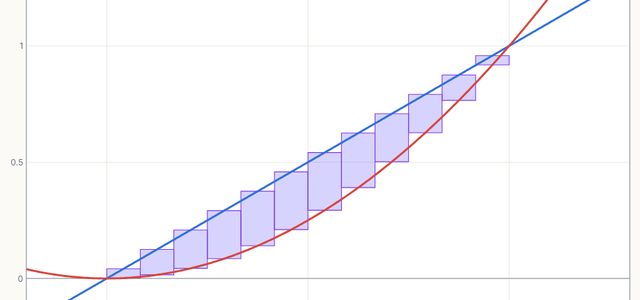 Applications of integralsArea, Volume & Arc Length
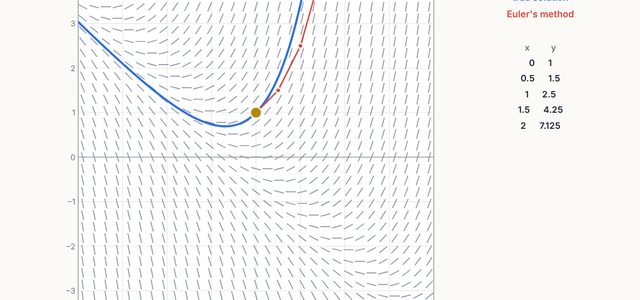 Differential equationsSlope Fields & Euler's Method
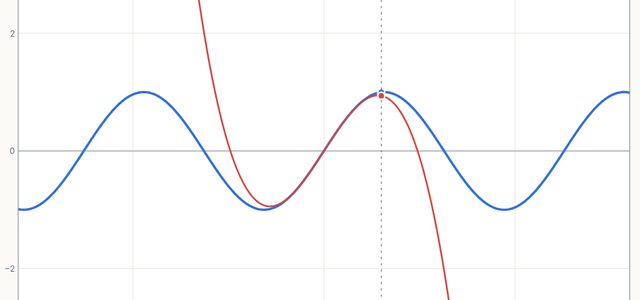 SeriesTaylor Polynomials & Series
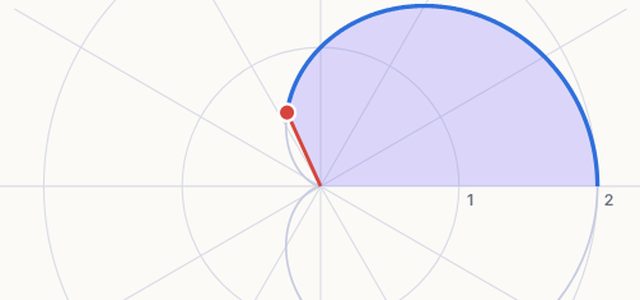 Parametric and polarPolar & Parametric Curves