The big idea
Polar coordinates locate a point by its distance r from the origin and its angle θ from the positive x-axis. Circles, cardioids and rose curves have simple polar equations. Area in polar form is built from thin sectors, not rectangles.
Key ideas
- Convert with x = r cos θ, y = r sin θ and r2 = x2 + y2.
- Area uses sectors: each has area (1/2)r2 dθ.
- For the area between two polar curves, integrate (1/2)(outer2 − inner2) between the angles where they meet.
- For slopes, treat x = r cos θ and y = r sin θ as parametric equations in θ.
- Sketch the curve to find the right limits. One petal or one loop is traced between consecutive zeros of r.
Equations
| x = r cos θ, y = r sin θ, r2 = x2 + y2 | conversion |
| A = (1/2) ∫αβ r2 dθ | polar area |
| dy/dx = (r′ sin θ + r cos θ)/(r′ cos θ − r sin θ) | slope, r′ = dr/dθ |
| L = ∫αβ √(r2 + (r′)2) dθ | arc length |
Worked questions: easy, medium, hard
Three questions that climb in difficulty, each solved one step at a time. Try each one before you read the steps.
(a) Convert the polar point (4, π/3) to Cartesian coordinates. (b) Convert r = 2 cos θ to a Cartesian equation.
- (a) x = 4 cos(π/3) = 2 and y = 4 sin(π/3) = 2√3: the point is (2, 2√3).
- (b) Multiply both sides by r: r2 = 2r cos θ.
- Replace: x2 + y2 = 2x, a circle of radius 1 centred at (1, 0).
Find the area of one petal of the rose r = 2 sin 2θ.
- r = 0 at θ = 0 and θ = π/2, so one petal is traced for 0 ≤ θ ≤ π/2.
- A = (1/2) ∫0π/2 4 sin2 2θ dθ = 2 ∫0π/2 sin2 2θ dθ.
- Use sin2 u = (1 − cos 2u)/2: the integral of sin2 2θ over this interval is π/4.
- A = 2(π/4) = π/2.
Find the area inside the circle r = 3 sin θ and outside the cardioid r = 1 + sin θ.
- Intersections: 3 sin θ = 1 + sin θ gives sin θ = 1/2, so θ = π/6 and 5π/6.
- A = (1/2) ∫ [9 sin2 θ − (1 + sin θ)2] dθ = (1/2) ∫ (8 sin2 θ − 1 − 2 sin θ) dθ.
- Use 8 sin2 θ = 4 − 4 cos 2θ: A = (1/2)[3θ − 2 sin 2θ + 2 cos θ] from π/6 to 5π/6.
- The sine and cosine terms cancel at each limit, leaving (1/2)(5π/2 − π/2) = π.
Common mistakes
- Forgetting the 1/2 in the area formula.
- Squaring the difference (outer − inner)2 instead of taking outer2 − inner2.
- Integrating from 0 to 2π for a curve that is traced out more than once on that interval.
Now you try: easy to hard
Six more questions, two at each level. These are the questions on the worksheet; each solution opens when you are ready.
Easy 1. Convert the Cartesian point (−1, 1) to polar coordinates.
Show the step-by-step solution
r = √(1 + 1) = √2. The point is in the second quadrant with tan θ = −1, so θ = 3π/4.
Easy 2. Use the polar area formula to find the area of the circle r = 5.
Show the step-by-step solution
A = (1/2) ∫02π 25 dθ = (1/2)(25)(2π) = 25π.
Medium 3. Find the area enclosed by the cardioid r = 1 + cos θ.
Show the step-by-step solution
A = (1/2) ∫02π (1 + 2 cos θ + cos2 θ) dθ = (1/2)(2π + 0 + π) = 3π/2.
Medium 4. Find the slope of r = 1 + cos θ at θ = π/2.
Show the step-by-step solution
r = 1 and r′ = −sin θ = −1. dy/dx = (r′ sin θ + r cos θ)/(r′ cos θ − r sin θ) = (−1 + 0)/(0 − 1) = 1.
Hard 5. Find the area of one petal of r = cos 3θ.
Show the step-by-step solution
One petal runs from θ = −π/6 to π/6. A = (1/2) ∫ cos2 3θ dθ = (1/2)(π/6) = π/12.
Hard 6. Find the total length of the cardioid r = 1 + cos θ.
Show the step-by-step solution
r2 + (r′)2 = (1 + cos θ)2 + sin2 θ = 2 + 2 cos θ = 4 cos2(θ/2). L = ∫02π 2|cos(θ/2)| dθ = 2 · ∫0π 2 cos(θ/2) dθ = 2 · 4 = 8.
6 questions to print or save, with full step-by-step answers at the end.
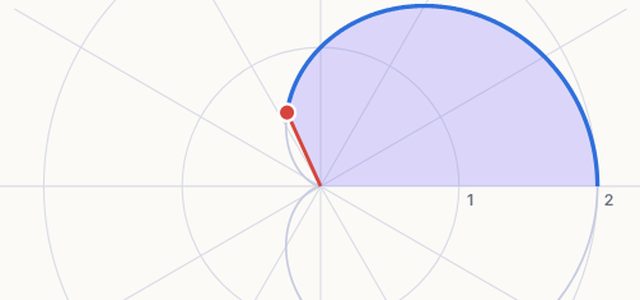
Open the Polar & Parametric Curves simulation and test every idea on this page yourself.
Open the simulation →