High School Mathematics
The American high school sequence that leads into AP Calculus: Algebra 1, Geometry, Algebra 2 and Pre-Calculus. 33 lessons in course-unit order, each linked to its simulation, with an exam-level section marked Easy · Medium · Hard.
Algebra 1
Expressions, Brackets and Rearranging Formulae
Collect like terms, expand and factorise, simplify algebraic fractions and change the subject of a formula.
Linear Equations and Inequalities
Solve equations with brackets, fractions and the unknown on both sides, and solve and represent inequalities.
Straight-Line Graphs
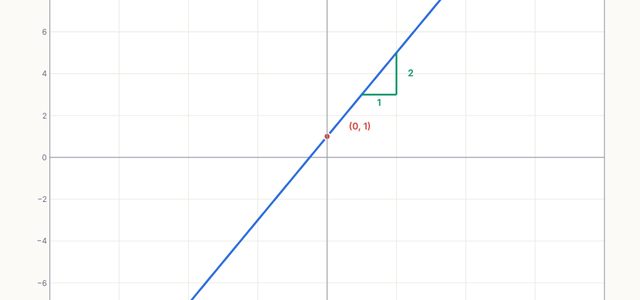
Gradient and intercept, the equation y = mx + c, parallel and perpendicular lines, midpoints and distances.
Simultaneous Equations
Find the values that satisfy two equations at once, by elimination, by substitution, and where a line meets a curve.
Indices, Standard Form and Surds
The laws of indices including negative and fractional powers, numbers in standard form, and exact answers with surds.
Quadratic Equations
Solve quadratics by factorising, by the formula and by completing the square, and link the solutions to the graph.
Sequences
Find and use nth-term rules for arithmetic, geometric and quadratic sequences.
Geometry
Angles, Parallel Lines and Polygons
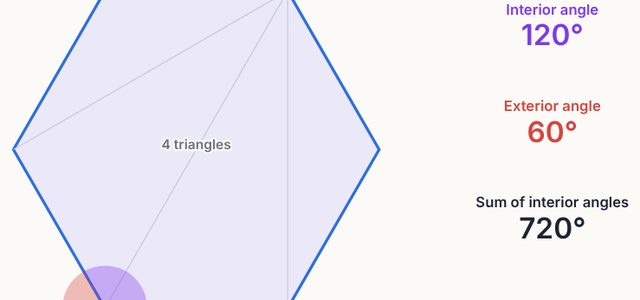
Angle facts for lines, triangles and parallel lines, and the interior and exterior angles of polygons.
Pythagoras' Theorem and Right-Angled Trigonometry
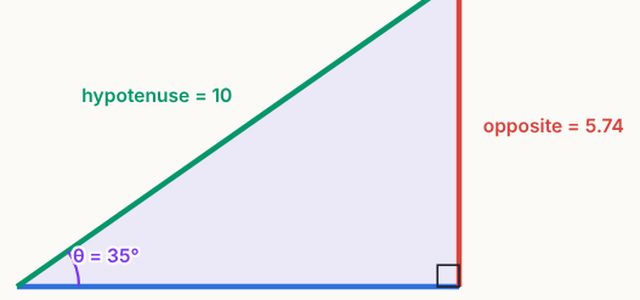
Find missing sides and angles in right-angled triangles, including problems in three dimensions.
The Sine Rule, Cosine Rule and Area of a Triangle
Trigonometry for triangles without a right angle: find sides, angles and areas.
Area, Volume and Similar Shapes
Areas of plane shapes and sectors, surface areas and volumes of solids, and how scale factors affect area and volume.
Circle Theorems
The angle facts for circles: angles at the centre and circumference, cyclic quadrilaterals, tangents and chords.
Transformations and Vectors
Translations, reflections, rotations and enlargements, column vectors, and vector methods for geometric proof.
Coordinate Geometry: Lines and Circles
Equations of lines and circles, completing the square to find a centre and radius, and tangents to circles.
Algebra 2
Functions, Curved Graphs and Transformations
Function notation, composite and inverse functions, the shapes of quadratic, cubic, reciprocal and exponential graphs, and graph transformations.
Quadratics, Inequalities and the Discriminant
Completing the square, surds, quadratic inequalities, and using the discriminant to count roots and find tangents.
Polynomials, the Factor Theorem and Binomial Expansion
Divide and factorise cubics with the factor theorem, and expand (a + b)ⁿ with binomial coefficients.
Rational Functions and Asymptotes
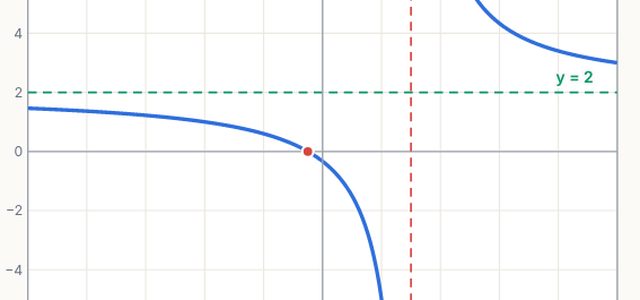
Graphs of one polynomial divided by another: holes, vertical, horizontal and slant asymptotes, and rational equations.
Exponentials and Logarithms
The laws of logarithms, solving equations with the unknown in the power, and exponential models of growth and decay.
Complex Numbers
The number i, arithmetic with complex numbers, complex roots of quadratics, and the complex plane.
Sequences, Series and the General Binomial Expansion
Arithmetic and geometric series, sums to infinity, and the binomial expansion for negative and fractional powers.
Statistics: Averages, Spread and Diagrams
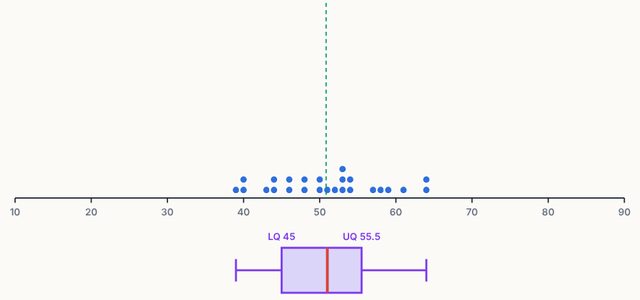
Mean, median, mode and range, estimates from grouped data, quartiles and box plots, and histograms.
Probability
Single and combined events, tree diagrams with and without replacement, Venn diagrams and conditional probability.
Statistics: Data, Probability and the Binomial Distribution
Standard deviation, probability rules, the binomial distribution and a first hypothesis test.
Pre-Calculus
Functions, the Modulus and Partial Fractions
Composite and inverse functions with their domains and ranges, modulus equations and inequalities, and partial fractions.
Trigonometric Identities and Equations
Use the graphs and symmetries of sin, cos and tan to find every solution in an interval, with the two key identities.
Radians and Further Trigonometry
Radian measure, arcs and sectors, the reciprocal functions, addition and double-angle formulae, and R sin(x + α).
Vectors in Three Dimensions
Magnitude, unit vectors, position vectors and the scalar product for angles and perpendicularity.
Matrices
Add and multiply matrices, find determinants and inverses of 2 × 2 matrices, and use them for equations and transformations.
Conic Sections
Parabolas, ellipses and hyperbolas from their equations: vertices, foci, directrix and asymptotes.
Parametric Equations and Vector-Valued Functions
Curves traced by x(t) and y(t): slopes, second derivatives, speed and distance travelled.
Polar Curves
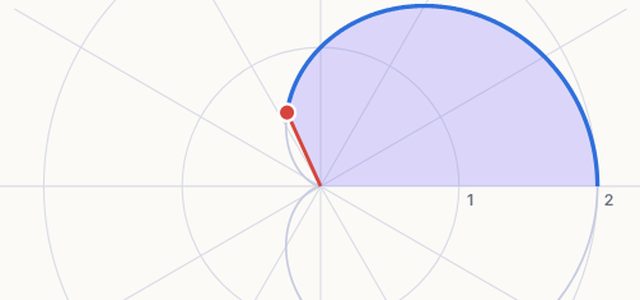
Points described by distance and angle: converting, slopes of polar curves, and areas swept out from the origin.
Limits and Limit Laws
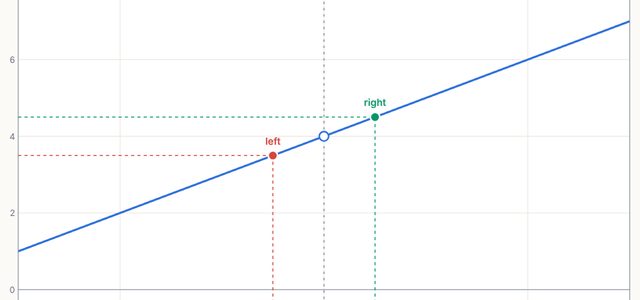
What a function approaches, and the algebra tricks (factor, conjugate, divide by the highest power) that find it.