The big idea
Vectors in 3D work exactly like vectors in 2D, with a third component. The scalar (dot) product multiplies two vectors to give a number, and it is the tool for finding the angle between them. A dot product of zero means the vectors are perpendicular.
Key ideas
- |a| = √(x² + y² + z²). A unit vector is a ÷ |a|.
- The vector from A to B is b − a.
- a · b = a₁b₁ + a₂b₂ + a₃b₃ = |a||b| cos θ.
- a · b = 0 ⇔ a and b are perpendicular.
- A point dividing AB in the ratio m : n has position vector a + [m/(m + n)](b − a).
Equations
| |a| = √(a12 + a22 + a32) | magnitude |
| a · b = a1b1 + a2b2 + a3b3 | scalar product |
| cos θ = (a · b)/(|a||b|) | angle between vectors |
| AB = b − a | displacement vector |
Worked questions: easy, medium, hard
Three questions that climb in difficulty, each solved one step at a time. Try each one before you read the steps.
a = (2, −1, 2). Find |a| and the unit vector in the direction of a.
- |a| = √(4 + 1 + 4) = √9 = 3.
- Divide each component by 3.
- Unit vector: (2/3, −1/3, 2/3).
Find the angle between a = (1, 2, 2) and b = (3, 0, 4).
- a · b = 3 + 0 + 8 = 11.
- |a| = 3 and |b| = 5.
- cos θ = 11/15.
- θ = 42.8°.
A(1, 2, 3), B(4, 6, 3) and C(1, 2, 8). Show that angle BAC is a right angle and find the area of triangle ABC.
- AB = (3, 4, 0) and AC = (0, 0, 5).
- AB · AC = 0 + 0 + 0 = 0, so AB is perpendicular to AC.
- |AB| = 5 and |AC| = 5.
- Area = (1/2)(5)(5) = 12.5.
Common mistakes
- Subtracting position vectors the wrong way round.
- Leaving the scalar product as a vector.
- Forgetting to divide by both magnitudes when finding an angle.
Now you try: easy to hard
Six more questions, two at each level. These are the questions on the worksheet; each solution opens when you are ready.
Easy 1. Work out (1, 2, 3) + 2(0, −1, 4).
Show the step-by-step solution
(1, 2 − 2, 3 + 8) = (1, 0, 11).
Easy 2. Find the distance between A(1, 0, 2) and B(3, 3, 8).
Show the step-by-step solution
AB = (2, 3, 6), |AB| = √(4 + 9 + 36) = 7.
Medium 3. Show that (2, 3, −1) and (4, −2, 2) are perpendicular.
Show the step-by-step solution
Dot product: 8 − 6 − 2 = 0, so they are perpendicular.
Medium 4. (p, 2, 1) is perpendicular to (3, −4, 2). Find p.
Show the step-by-step solution
3p − 8 + 2 = 0, so p = 2.
Hard 5. A(0, 3, 6) and B(9, 0, 0). Find the point P on AB with AP : PB = 1 : 2.
Show the step-by-step solution
OP = a + (1/3)(b − a) = (0, 3, 6) + (3, −1, −2) = (3, 2, 4).
Hard 6. Find the angle between (1, 1, 0) and (0, 1, 1).
Show the step-by-step solution
Dot product 1; each magnitude is √2. cos θ = 1/2, so θ = 60°.
6 questions to print or save, with full step-by-step answers at the end.
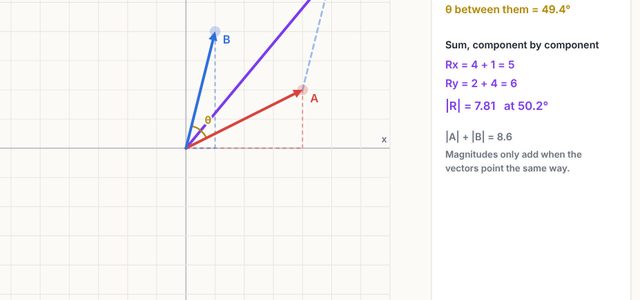
Open the Vectors: Add, Dot & Cross simulation and test every idea on this page yourself.
Open the simulation →