The big idea
A series is the sum of a sequence. Arithmetic and geometric series have formulas for their sums, and a geometric series with |r| < 1 even has a finite sum to infinity. The binomial expansion extends to any power, giving an infinite series that is valid only for small enough x.
Key ideas
- Arithmetic: common difference d. Geometric: common ratio r.
- A geometric series converges only if |r| < 1.
- For (1 + x)n with n not a positive integer, the expansion never ends and is valid for |x| < 1.
- For (a + bx)n, take out an first to get the form (1 + …)n, and adjust the validity condition.
Equations
| un = a + (n − 1)d, Sn = (n/2)[2a + (n − 1)d] | arithmetic |
| un = arn−1, Sn = a(1 − rn)/(1 − r) | geometric |
| S∞ = a/(1 − r), |r| < 1 | sum to infinity |
| (1 + x)n = 1 + nx + n(n − 1)x2/2! + …, |x| < 1 | general binomial |
Worked questions: easy, medium, hard
Three questions that climb in difficulty, each solved one step at a time. Try each one before you read the steps.
An arithmetic sequence has first term 3 and common difference 4. Find the 10th term and the sum of the first 10 terms.
- u10 = 3 + 9 × 4 = 39.
- S10 = (10/2)(first + last) = 5(3 + 39).
- = 210.
A geometric series has first term 8 and common ratio 1/2. Find the 6th term, the sum of the first 5 terms and the sum to infinity.
- u6 = 8 × (1/2)5 = 0.25.
- S5 = 8(1 − 1/32)/(1/2) = 16 × 31/32 = 15.5.
- S∞ = 8/(1 − 1/2) = 16.
Expand (1 + 2x)−2 up to the term in x2 and state the values of x for which it is valid.
- Use (1 + u)n with n = −2 and u = 2x.
- 1 + (−2)(2x) + [(−2)(−3)/2](2x)2.
- = 1 − 4x + 12x2.
- Valid when |2x| < 1, that is |x| < 1/2.
Common mistakes
- Using the sum to infinity when |r| ≥ 1.
- Forgetting to square the coefficient: (2x)2 is 4x2.
- Leaving out the validity condition.
Now you try: easy to hard
Six more questions, two at each level. These are the questions on the worksheet; each solution opens when you are ready.
Easy 1. Find the sum of the first 20 terms of 2, 5, 8, …
Show the step-by-step solution
a = 2, d = 3. S20 = 10[4 + 19 × 3] = 10 × 61 = 610.
Easy 2. Find the 7th term of 5, 15, 45, …
Show the step-by-step solution
r = 3: 5 × 36 = 5 × 729 = 3645.
Medium 3. The 5th term of an arithmetic sequence is 17 and the 9th is 33. Find a and d.
Show the step-by-step solution
4d = 16, so d = 4. Then a + 16 = 17, so a = 1.
Medium 4. Find the sum to infinity of 12 + 4 + 4/3 + …
Show the step-by-step solution
r = 1/3. S∞ = 12/(2/3) = 18.
Hard 5. Expand √(1 + x) up to x2 and use it to estimate √1.04.
Show the step-by-step solution
1 + x/2 + [(1/2)(−1/2)/2]x2 = 1 + x/2 − x2/8. With x = 0.04: 1 + 0.02 − 0.0002 = 1.0198.
Hard 6. A geometric series has first term 8 and sum to infinity 20. Find r and the least number of terms whose sum exceeds 19.
Show the step-by-step solution
8/(1 − r) = 20 gives r = 0.6. Need 20(1 − 0.6n) > 19, so 0.6n < 0.05 and n > ln 0.05/ln 0.6 = 5.86. n = 6.
6 questions to print or save, with full step-by-step answers at the end.
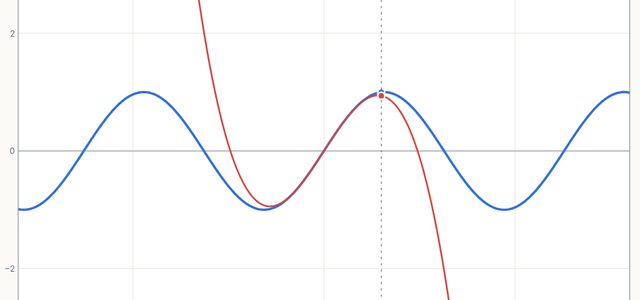
Open the Taylor Polynomials & Series simulation and test every idea on this page yourself.
Open the simulation →