The big idea
A circle is the set of points a fixed distance from its centre, which gives the equation (x − a)² + (y − b)² = r². Most circle problems combine that equation with one geometric fact: a tangent is perpendicular to the radius at the point of contact.
Key ideas
- (x − a)2 + (y − b)2 = r2 has centre (a, b) and radius r.
- If the equation is expanded, complete the square in x and in y to find the centre and radius.
- The tangent at a point is perpendicular to the radius to that point.
- A line meets a circle at 2, 1 or 0 points: substitute and look at the discriminant.
- The angle in a semicircle is 90°, so a diameter's endpoints give the centre (midpoint) and radius.
Equations
| (x − a)2 + (y − b)2 = r2 | circle, centre (a, b) |
| y − y1 = m(x − x1) | line through a point |
| m1m2 = −1 | perpendicular |
| d = √((x2 − x1)2 + (y2 − y1)2) | distance |
Worked questions: easy, medium, hard
Three questions that climb in difficulty, each solved one step at a time. Try each one before you read the steps.
State the centre and radius of x2 + y2 = 25 and show that (3, 4) lies on it.
- Compare with x2 + y2 = r2: centre (0, 0), radius 5.
- Substitute: 32 + 42 = 9 + 16 = 25.
- The equation is satisfied, so (3, 4) is on the circle.
Find the centre and radius of x2 + y2 − 6x + 4y − 12 = 0.
- Group: (x2 − 6x) + (y2 + 4y) = 12.
- Complete each square: (x − 3)2 − 9 + (y + 2)2 − 4 = 12.
- (x − 3)2 + (y + 2)2 = 25.
- Centre (3, −2), radius 5.
Find the equation of the tangent to (x − 3)2 + (y + 2)2 = 25 at the point (6, 2).
- Gradient of the radius from (3, −2) to (6, 2): (2 + 2)/(6 − 3) = 4/3.
- The tangent is perpendicular: gradient −3/4.
- y − 2 = −(3/4)(x − 6).
- Multiply by 4 and rearrange: 3x + 4y = 26.
Common mistakes
- Reading the centre of (x − 3)2 + (y + 2)2 = 25 as (−3, 2).
- Giving r2 as the radius.
- Using the radius gradient for the tangent.
Now you try: easy to hard
Six more questions, two at each level. These are the questions on the worksheet; each solution opens when you are ready.
Easy 1. Find the distance between (−1, 2) and (5, 10).
Show the step-by-step solution
√(62 + 82) = 10.
Easy 2. Write the equation of the circle with centre (2, −1) and radius 3.
Show the step-by-step solution
(x − 2)2 + (y + 1)2 = 9.
Medium 3. Find the line through (2, 3) perpendicular to 3x − y = 4.
Show the step-by-step solution
The given line has gradient 3, so the perpendicular gradient is −1/3: y − 3 = −(1/3)(x − 2).
Medium 4. A circle has diameter from (0, 0) to (6, 8). Find its equation.
Show the step-by-step solution
Centre = midpoint (3, 4). Radius = half of 10 = 5. (x − 3)2 + (y − 4)2 = 25.
Hard 5. Find where the line y = x + 1 meets the circle x2 + y2 = 13.
Show the step-by-step solution
x2 + (x + 1)2 = 13 gives x2 + x − 6 = 0, so x = 2 or −3. Points (2, 3) and (−3, −2).
Hard 6. Show that y = 2x + 5 is a tangent to x2 + y2 = 5 and find the point of contact.
Show the step-by-step solution
x2 + (2x + 5)2 = 5 gives 5x2 + 20x + 20 = 0, so (x + 2)2 = 0: a repeated root, so the line is a tangent. x = −2, y = 1: (−2, 1).
6 questions to print or save, with full step-by-step answers at the end.
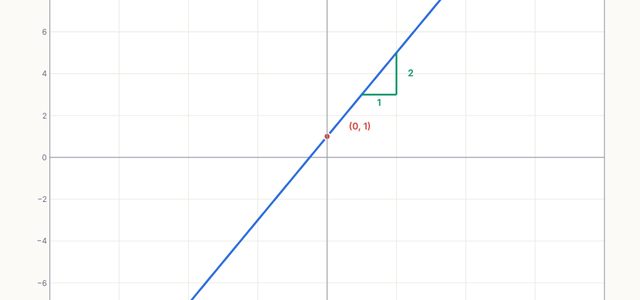
Open the Function Graphs simulation and test every idea on this page yourself.
Open the simulation →