The big idea
A function is a rule that turns an input into an output, written f(x). Its graph shows every input–output pair. Knowing the standard shapes, and how changes to the formula shift or stretch them, lets you sketch a curve without a table of values.
Key ideas
- f(3) means substitute x = 3. fg(x) means do g first, then f.
- The inverse f−1 undoes f. Find it by writing y = f(x) and making x the subject.
- Quadratics are parabolas, cubics have an S-shape, y = 1/x has two branches with asymptotes, and y = ax rises faster and faster.
- f(x) + a moves the graph up a. f(x + a) moves it left a. af(x) stretches it vertically. f(ax) squashes it horizontally by factor 1/a. −f(x) reflects in the x-axis.
Equations
| fg(x) = f(g(x)) | composite function |
| f(f−1(x)) = x | inverse function |
| y = f(x − a) + b | translation by a right and b up |
| y = abx | exponential |
Worked questions: easy, medium, hard
Three questions that climb in difficulty, each solved one step at a time. Try each one before you read the steps.
f(x) = 2x + 3. Find f(4) and solve f(x) = 1.
- f(4) = 2(4) + 3 = 11.
- f(x) = 1 means 2x + 3 = 1.
- 2x = −2, so x = −1.
Sketch y = x2 − 2x − 3, giving the intercepts and the turning point.
- y-intercept: x = 0 gives y = −3.
- Roots: (x − 3)(x + 1) = 0, so x = 3 and x = −1.
- The turning point is halfway between the roots, at x = 1: y = 1 − 2 − 3 = −4.
- A U-shaped parabola through (−1, 0), (0, −3) and (3, 0) with minimum (1, −4).
f(x) = 3x − 1 and g(x) = x2. Find fg(2), gf(x) and f−1(x).
- fg(2): g first, g(2) = 4, then f(4) = 11.
- gf(x): f first, giving 3x − 1, then square: (3x − 1)2.
- Inverse: y = 3x − 1, so x = (y + 1)/3.
- f−1(x) = (x + 1)/3.
Common mistakes
- Doing fg(x) in the wrong order.
- Moving the graph right for f(x + a). It moves left.
- Thinking f−1(x) means 1/f(x).
Now you try: easy to hard
Six more questions, two at each level. These are the questions on the worksheet; each solution opens when you are ready.
Easy 1. f(x) = x2 + 1. Find f(−3).
Show the step-by-step solution
(−3)2 + 1 = 10.
Easy 2. Find the intercepts of y = x2 − 4.
Show the step-by-step solution
x = 0 gives y = −4. y = 0 gives x = ±2. (0, −4), (2, 0), (−2, 0).
Medium 3. The graph of y = x2 is moved 3 right and 2 up. Write its equation and turning point.
Show the step-by-step solution
y = (x − 3)2 + 2, with minimum at (3, 2).
Medium 4. Find the inverse of f(x) = 5x + 2.
Show the step-by-step solution
y = 5x + 2, so x = (y − 2)/5. f−1(x) = (x − 2)/5.
Hard 5. y = f(x) has a maximum at (2, 5). Find the maximum of (a) y = f(x + 3), (b) y = 2f(x), (c) y = f(2x).
Show the step-by-step solution
(a) 3 left: (−1, 5). (b) y doubled: (2, 10). (c) x halved: (1, 5).
Hard 6. The curve y = abx passes through (0, 3) and (2, 12). Find a and b (b > 0) and the value of y when x = 5.
Show the step-by-step solution
x = 0 gives a = 3. Then 3b2 = 12, so b = 2. y = 3 × 25 = 96.
6 questions to print or save, with full step-by-step answers at the end.
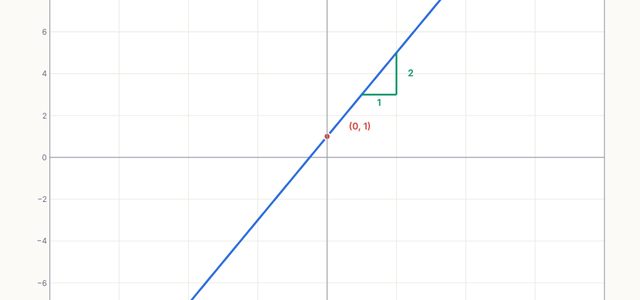
Open the Function Graphs simulation and test every idea on this page yourself.
Open the simulation →