The big idea
A transformation moves or resizes a shape. A vector describes a movement with both size and direction, written as a column. Vectors can be added tip to tail, and two vectors are parallel when one is a multiple of the other.
Key ideas
- Translation: slide by a vector. Reflection: flip in a mirror line. Rotation: turn about a centre. Enlargement: scale from a centre.
- An enlargement with scale factor k multiplies lengths by k and areas by k². A negative k puts the image on the other side of the centre.
- Add vectors by adding components. The vector from A to B is b − a.
- If one vector is a multiple of another they are parallel. If they also share a point, the points are collinear.
Equations
| AB = b − a | vector from A to B |
| |(x, y)| = √(x2 + y2) | magnitude |
| k(x, y) = (kx, ky) | scalar multiple |
| OM = (1/2)(a + b) | midpoint of AB |
Worked questions: easy, medium, hard
Three questions that climb in difficulty, each solved one step at a time. Try each one before you read the steps.
The point (2, 3) is translated by the vector (4, −5). Find the image.
- Add the vector to the coordinates.
- x: 2 + 4 = 6. y: 3 − 5 = −2.
- Image: (6, −2).
A triangle has vertices (1, 1), (3, 1) and (1, 2). It is enlarged by scale factor 3 with centre (0, 0). Find the new vertices and the new area.
- With centre (0, 0), multiply every coordinate by 3: (3, 3), (9, 3), (3, 6).
- Original area: (1/2)(2)(1) = 1.
- Area scale factor is 32 = 9.
- New area: 9.
OA = a and OB = b. M is the midpoint of AB, and P lies on AB with AP : PB = 1 : 3. Find OM and OP in terms of a and b.
- AB = b − a.
- OM = OA + (1/2)AB = a + (1/2)(b − a) = (1/2)a + (1/2)b.
- P is one quarter of the way from A to B: OP = a + (1/4)(b − a).
- OP = (3/4)a + (1/4)b.
Common mistakes
- Writing AB as a − b.
- Describing a rotation without its centre, angle and direction.
- Squaring the scale factor for lengths, or not squaring it for areas.
Now you try: easy to hard
Six more questions, two at each level. These are the questions on the worksheet; each solution opens when you are ready.
Easy 1. Reflect the point (3, −2) in the x-axis and in the line y = x.
Show the step-by-step solution
In the x-axis: (3, 2). In y = x, swap the coordinates: (−2, 3).
Easy 2. Rotate (4, 1) by 90° anticlockwise about the origin.
Show the step-by-step solution
(x, y) → (−y, x): (−1, 4).
Medium 3. a = (3, 4). Find |a| and 2a.
Show the step-by-step solution
|a| = √(9 + 16) = 5. 2a = (6, 8).
Medium 4. a = (2, 5) and b = (−1, 3). Find a + b and a − 2b.
Show the step-by-step solution
a + b = (1, 8). a − 2b = (2 + 2, 5 − 6) = (4, −1).
Hard 5. Find the image of (1, 3) under an enlargement of scale factor −2, centre the origin.
Show the step-by-step solution
Multiply by −2: (−2, −6), on the opposite side of the origin and twice as far away.
Hard 6. OA = a, OB = b, OC = 3a and OD = 3b. Show that CD is parallel to AB and compare their lengths.
Show the step-by-step solution
AB = b − a. CD = 3b − 3a = 3(b − a) = 3AB. CD is a multiple of AB, so they are parallel, and CD is 3 times as long.
6 questions to print or save, with full step-by-step answers at the end.
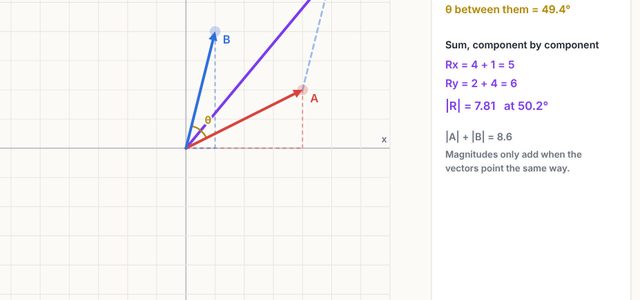
Open the Vectors: Add, Dot & Cross simulation and test every idea on this page yourself.
Open the simulation →