The big idea
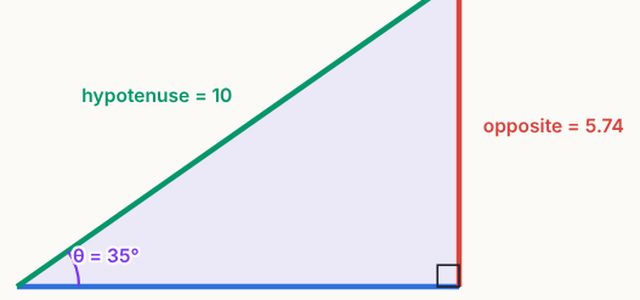
In a right-angled triangle the three sides are linked by Pythagoras' theorem, and the sides and angles are linked by the ratios sin, cos and tan. Label the sides from the angle you are using: opposite, adjacent and hypotenuse.
Key ideas
- The hypotenuse is the longest side, opposite the right angle.
- Pythagoras: square the two shorter sides and add to get the square of the hypotenuse. To find a shorter side, subtract.
- SOH CAH TOA: sin = opp/hyp, cos = adj/hyp, tan = opp/adj.
- To find an angle, use the inverse function: sin−1, cos−1 or tan−1.
- In 3D, find a right-angled triangle inside the shape and work in two steps.
Equations
| a2 + b2 = c2 | Pythagoras' theorem |
| sin θ = opp/hyp | SOH |
| cos θ = adj/hyp | CAH |
| tan θ = opp/adj | TOA |
Worked questions: easy, medium, hard
Three questions that climb in difficulty, each solved one step at a time. Try each one before you read the steps.
A right-angled triangle has shorter sides 6 cm and 8 cm. Find the hypotenuse.
- c2 = 62 + 82 = 36 + 64 = 100.
- c = √100.
- c = 10 cm.
In a right-angled triangle the side opposite angle θ is 5 cm and the adjacent side is 12 cm. Find θ.
- Opposite and adjacent are known, so use tan.
- tan θ = 5/12.
- θ = tan−1(5/12) = 22.6°.
A cuboid measures 3 cm by 4 cm by 12 cm (height 12 cm). Find the length of its space diagonal and the angle it makes with the base.
- Diagonal of the base: √(32 + 42) = 5 cm.
- The space diagonal is the hypotenuse of a triangle with sides 5 and 12: √(25 + 144) = 13 cm.
- Angle with the base: tan θ = 12/5.
- θ = tan−1(2.4) = 67.4°.
Common mistakes
- Adding the squares when finding a shorter side.
- Labelling opposite and adjacent from the wrong angle.
- Having the calculator in radians.
Now you try: easy to hard
Six more questions, two at each level. These are the questions on the worksheet; each solution opens when you are ready.
Easy 1. A right-angled triangle has hypotenuse 13 cm and one side 5 cm. Find the third side.
Show the step-by-step solution
132 − 52 = 169 − 25 = 144, so the side is 12 cm.
Easy 2. The hypotenuse is 10 cm and an angle is 30°. Find the side opposite the 30° angle.
Show the step-by-step solution
opp = hyp × sin 30° = 10 × 0.5 = 5 cm.
Medium 3. A 6 m ladder has its foot 2 m from a wall. How high up the wall does it reach, and what angle does it make with the ground?
Show the step-by-step solution
Height = √(36 − 4) = √32 = 5.66 m. cos θ = 2/6, so θ = 70.5°.
Medium 4. The side adjacent to a 40° angle is 7 cm. Find the hypotenuse.
Show the step-by-step solution
cos 40° = 7/hyp, so hyp = 7/cos 40° = 9.14 cm.
Hard 5. From a point 50 m from the foot of a tower, the angle of elevation of the top is 35°. Find the height of the tower.
Show the step-by-step solution
height = 50 × tan 35° = 35.0 m.
Hard 6. Use an equilateral triangle of side 2 to find the exact value of sin 60° and the area of the triangle.
Show the step-by-step solution
Split it in half: base 1, hypotenuse 2, so height = √(4 − 1) = √3. sin 60° = √3/2. Area = (1/2)(2)(√3) = √3.
6 questions to print or save, with full step-by-step answers at the end.
Open the Trigonometry Lab simulation and test every idea on this page yourself.
Open the simulation →